
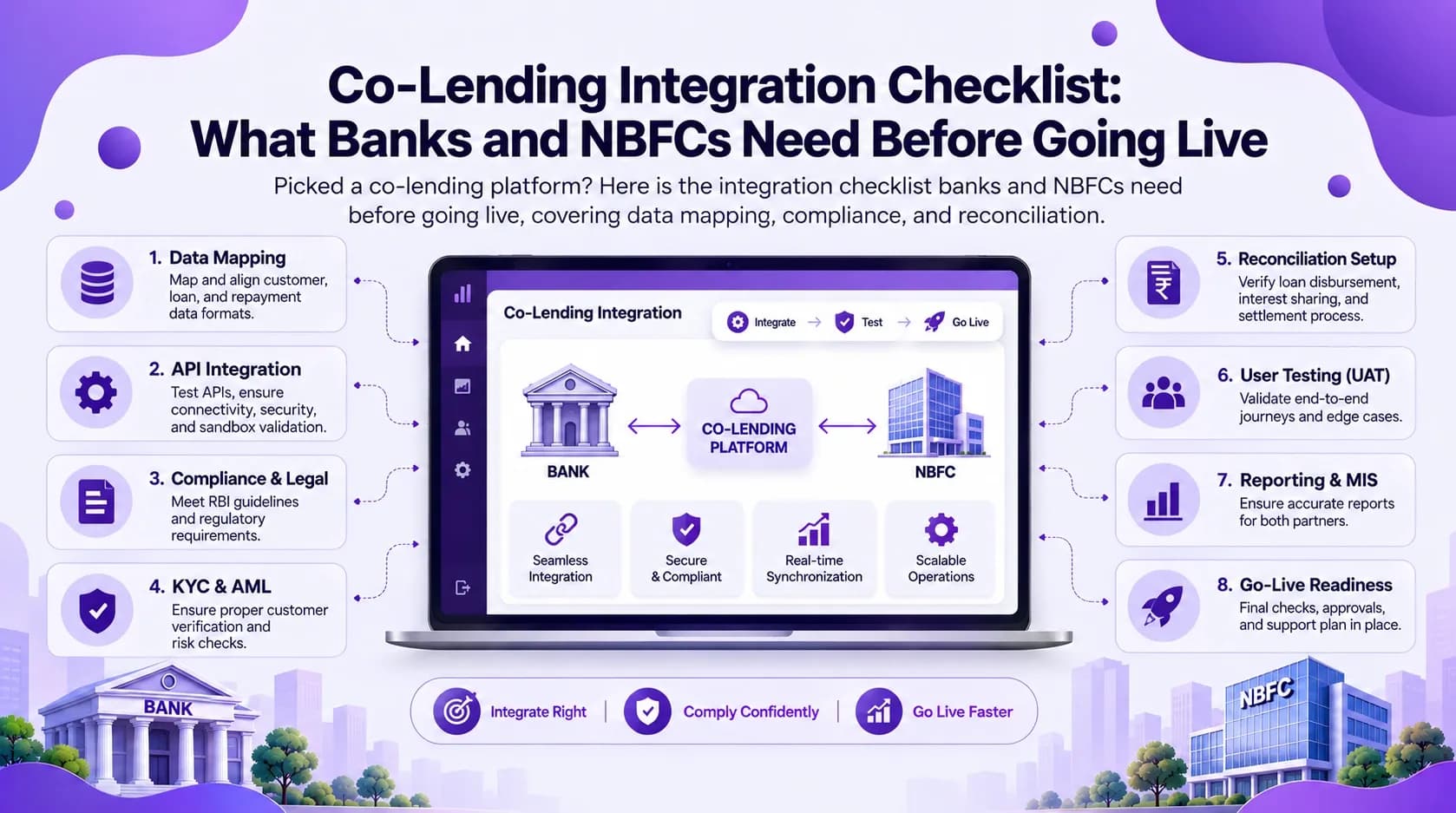
Co-Lending Integration Checklist: What Banks and NBFCs Need Before Going Live
Before a co-lending partnership goes live, both the bank and the NBFC need to confirm five things work end to end: real-time data sharing between systems, automatic blended rate and loss-split calculation, RBI-compliant disclosures, a tested fund transfer flow within the 15-day window, and a reconciliation process both sides can independently check. Skipping any of these at the integration stage is usually what causes problems three to six months after launch.
Introduction
Choosing a co-lending platform is only half the job. The harder part, and the part that usually gets rushed, is actually integrating it between the bank and the NBFC before the first loan goes out. If you have already gone through how to choose a co-lending platform, this is the next step: making sure it actually works the way it is supposed to once real loans and real money are moving through it.
This checklist covers what to test and confirm before going live, so problems show up during integration, not after you have already disbursed loans to real borrowers.
Before Integration Starts
1. Confirm Both Systems Can Actually Talk to Each Other
Before any real integration work begins, confirm that the NBFC’s loan origination system and the bank’s lending system can connect through APIs, not through manual file exports. Ask for a technical walkthrough of exactly what data moves automatically and what still needs manual entry.
2. Align on the Loan Split and Retention Ratio
Agree on the funding split between the bank and the NBFC upfront, and confirm both sides understand the minimum 10% retention requirement under RBI’s 2025 Co-Lending Directions applies to each lender individually, not just one side.
3. Finalise the Co-Lending Agreement Terms
Get the formal agreement in place covering sourcing responsibility, servicing responsibility, grievance handling, and how the blended interest rate will be calculated and disclosed. This should be finalised before technical integration, not worked out alongside it.
During Integration
4. Test Real-Time Data Sync, Not Just a One-Time Upload
Run test loans through the system and confirm that KYC data, credit bureau checks, and sanction details sync between the bank and NBFC in real time. A platform that only works during a demo with clean, pre-loaded data is not the same as one that works with live, messy data.
5. Test the Blended Rate Calculation on Multiple Scenarios
Do not just test the standard case. Run scenarios where the bank’s rate changes, where the split ratio is different from the default, and confirm the blended rate recalculates correctly and the borrower-facing disclosure updates automatically.
6. Test the Fund Transfer Timeline End to End
Actually run a test disbursal and repayment cycle and time how long it takes for funds to move between the bank and NBFC. Confirm this comfortably falls within the 15-day window required under the 2025 Directions, with room to spare, not right at the edge.
7. Confirm the Key Facts Statement Generates Correctly
Check that the borrower-facing Key Facts Statement automatically includes each lender’s share, the applicable rate and charges, servicing responsibility, and complaint escalation details, without anyone manually compiling it loan by loan.
8. Set Up the Shared Reconciliation View
Before going live, confirm that both the bank and the NBFC can independently pull the same reconciliation report from the connected loan management system, and that it updates daily rather than requiring a manual comparison at month end.
After Going Live
9. Run a Small Batch Before Scaling Up
Start with a limited number of loans rather than opening the flow fully on day one. This makes it much easier to catch and fix issues while the volume is still small.
10. Review the First Reconciliation Cycle Closely
Once the first batch of loans has gone through a full cycle, sit down with both teams and go through the reconciliation report line by line. This is where mismatches, if any, tend to show up first.
11. Confirm Audit Readiness
Make sure the platform can produce a clear, timestamped record of KYC checks, approvals, disbursals, fund transfers, and repayments for every loan, so you are not scrambling to assemble this manually if RBI or an internal audit team asks for it.
Quick Checklist Summary
| Stage | What to Confirm |
|---|---|
| Before integration | Systems can connect via API, split ratio agreed, contract finalised |
| During integration | Real-time sync tested, blended rate tested, fund transfer timed, disclosures automated, reconciliation shared |
| After going live | Small batch first, first reconciliation reviewed, audit trail confirmed |
Common Mistakes at the Integration Stage
- Testing only with clean sample data instead of the messier, real-world data that comes through in production
- Assuming the blended rate calculation works without testing it against a rate change or a non-standard split
- Going live with the full loan volume immediately, instead of starting with a small batch
- Not reviewing the first reconciliation cycle closely enough to catch small mismatches before they become a pattern
Conclusion
Choosing the right co-lending platform gets you halfway there. The integration stage is where the partnership either holds up under real volume or starts showing cracks. Going through this checklist before launch, and starting with a small batch rather than full volume, is what separates a co-lending partnership that runs smoothly from one that turns into a monthly reconciliation headache.
FAQs
Q - How long does co-lending integration usually take?
It depends on how complex each partner’s existing systems are, but integrating a bank and an NBFC for co-lending typically takes a few weeks to a few months once the platform has been chosen.
Q - What should be tested before a co-lending partnership goes live?
At minimum, real-time data sync, blended rate calculation, the fund transfer timeline, automated borrower disclosures, and a shared reconciliation view should all be tested with real test loans before launch.
Q - Should co-lending go live with full volume immediately?
No. It is safer to start with a small batch of loans, review the full cycle including reconciliation, and only then scale up to full volume.
Q - What causes most co-lending integration problems?
Most problems trace back to skipped or rushed testing, especially around blended rate calculation, fund transfer timing, and reconciliation, rather than the core platform itself. Need help planning a co-lending integration? Book a demo with iFLOW and walk through the setup with our team.