
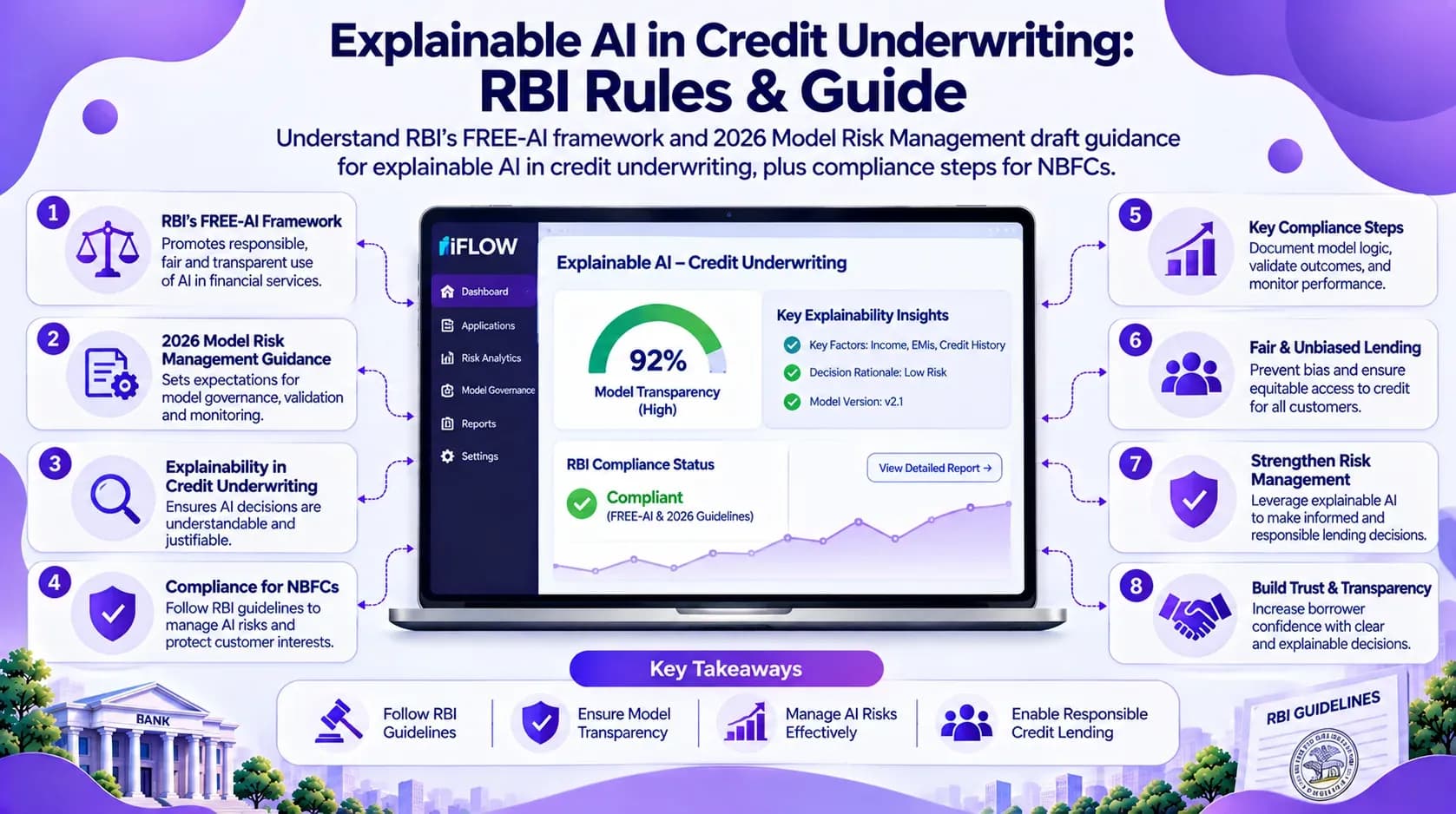
Explainable AI in Credit Underwriting: What RBI Expects From Lenders
Explainable AI in credit underwriting means a lender can clearly state why an AI model approved, rejected, or priced a loan. RBI’s FREE-AI framework (August 2025) recommends that AI used in credit decisions be explainable, auditable, and free of discriminatory bias. RBI’s draft Model Risk Management guidance (June 2026) goes further, requiring board oversight, risk-based model tiering, human control, and full lender accountability even for third-party vendor models.
Introduction
Picture a borrower who applies for a ₹5 lakh business loan and gets rejected. They call your branch and ask why. If the answer is “the system decided,” you have a regulatory problem, not just a customer service problem.
The Reserve Bank of India (RBI) has put its expectations for AI in lending into writing across two major policy documents. First came the Report of the Committee to Develop a Framework for Responsible and Ethical Enablement of Artificial Intelligence (FREE-AI) in August 2025, followed by the draft Guidance on Regulatory Principles for Model Risk Management on 24 June 2026. Both reinforce one core rule: if a model helps decide who gets credit, the lender must be able to explain how it works and remain in control of its outcomes.
This guide breaks down what explainable AI in credit underwriting means, what RBI has laid out so far, and the practical steps NBFCs and banks can take today.
What Is AI in Credit Underwriting?
Credit underwriting is how a lender decides whether to approve a loan, how much to sanction, and at what interest rate. AI in credit underwriting uses machine learning models to support that call. Instead of relying solely on a static rule-based scorecard, an AI model evaluates data such as credit bureau history, bank statement cash flows, GST filings, and repayment behaviour to estimate repayment probability. The advantage is speed and financial inclusion. Machine learning models process thousands of variables faster than manual review and can underwrite thin-file or new-to-credit borrowers whom traditional scorecards reject. The catch is opacity: complex models often generate a credit score without stating the reason behind it. That gap is what explainability solves.
What Is Explainable AI in Credit Underwriting?
Explainable AI in credit underwriting is the ability to show which specific factors drove a model’s decision, in plain terms that a credit officer, an auditor, or a borrower can follow. Under Chapter IV of RBI’s June 2026 draft Model Risk Management guidance, explainability is defined along these exact lines: a model’s capability to reveal the primary drivers behind its output in a human-understandable format.
Why Explainability Matters Now: RBI’s Timeline
For over two decades, credit models operated under rules drafted long before machine learning entered retail and MSME lending. RBI is actively modernising that framework. Here is how the regulatory timeline has unfolded:
Once finalised, the 2026 Model Risk Management guidance will replace Chapter 3 (Credit Risk Models) of RBI’s Guidance Note on Credit Risk Management from 2002. In short, RBI is rewriting the rulebook for credit models with AI and machine learning at the centre.
What the RBI FREE-AI Framework Says About Credit Decisions
Released on 13 August 2025, the RBI FREE-AI report is structured around seven foundational principles called “sutras.” Three of those sutras apply directly to credit underwriting: Fairness and Equity, Accountability, and Understandable by Design.
For banks and NBFCs deploying AI in underwriting, five recommendations stand out:
- A board-approved AI policy: Every regulated entity should adopt an AI governance policy signed off by its board.
- Explainable and auditable models: AI used in credit assessment, underwriting, and customer service must be explainable, auditable, and free of discriminatory bias.
- Customer transparency and Digital Lending alignment: Borrowers should know when AI informs a credit decision and have a clear mechanism to challenge outcomes reinforcing the transparency norms under the RBI (Digital Lending) Directions, 2025.
- Vendor accountability: Outsourcing contracts must address AI model risks, data confidentiality, and clear liability when a third-party score fails.
- Model risk management for AI: Internal validation, stress testing, and audit frameworks must be extended to cover machine learning models.
While the FREE-AI report consists of committee recommendations rather than standalone binding rules, it set the policy direction that RBI’s 2026 draft guidance turns into concrete operational expectations.
What RBI’s Draft Model Risk Management Guidance Means for NBFCs
Issued on 24 June 2026, RBI’s draft Guidance on Regulatory Principles for Model Risk Management applies broadly across India’s financial sector: commercial banks, small finance banks, payments banks, cooperative banks, NBFCs across all four scale-based layers (Base, Middle, Upper, and Top), All India Financial Institutions, asset reconstruction companies, and credit information companies. An NBFC does not need to be in the Upper Layer to fall within its scope.
Note on regulatory status: In its 24 June 2026 release, RBI invited public comments on the draft guidance through 24 July 2026. Because final provisions may evolve after industry consultation, lenders should verify the final circular on rbi.org.in before locking in formal compliance manuals.
How Explainability Works in Practice
Explainability is not a single toggle you switch on before an audit. It is a set of engineering and underwriting habits built into your loan origination workflow.
1. Reason Codes for Every Decision
Every approval, rejection or pricing decision should come with the top reasons in plain language. For the ₹5 lakh loan from the start of this guide, that could look like this:
- Existing monthly EMI load is high compared to verified income
- Two missed repayments in the last six months
- Business bank balance dipped below the monthly minimum three times this quarter
A credit officer can read that, and so can the borrower. It also gives your grievance team something real to work with.
2. Feature Importance Tools (SHAP and LIME)
Tools like SHAP and LIME show how much each input pushed a score up or down. In simple terms, they turn “the score is 612” into “income stability added points, recent missed payments took points away.” Legal commentary on the FREE-AI framework specifically mentions these tools as a way to make models explainable.
3. Decision Logs and Immutable Audit Trails
For each decision, keep a record of the inputs, the model version, the score, the outcome and whether a human changed it. RBI’s draft asks for documentation detailed enough for traceability, reproducibility and auditability. If an auditor asks why a loan was rejected eight months ago, you should be able to replay it.
4. Human Override and Automation Bias Controls
Borderline cases and large loans should have a person who can review and override the model. The draft guidance also says the people doing this oversight need enough understanding to challenge the model, and it warns about automation bias, where reviewers trust the model too much and stop questioning it.
5. Human Override and Automation Bias Controls
A model that worked well last year can slowly get worse as borrower behaviour changes. That is data drift and concept drift, and RBI’s draft asks lenders to monitor both. Fairness checks should be repeated too, not done once at launch.
Where Agentic AI Fits in Credit Underwriting
Agentic AI in credit underwriting means AI that carries out several steps on its own, instead of answering one question at a time. An AI agent might collect documents, pull out the numbers, run policy checks and draft a credit note for a human to review.
That is useful, especially for the preparation work that eats up an underwriter’s day. But more autonomy means more risk. RBI’s draft says the risk tier of an AI model should take into account how much the lender relies on the model and how much autonomy it has.
A sensible way to use agents: let them do the prep work, keep the final approval with an explainable model and a human, and log every step the agent takes. The more an AI agent can do without a person checking, the stronger the controls around it need to be.
How iFLOW Supports Explainable, RBI-Ready Credit Underwriting
Meeting RBI’s expectations on explainability takes more than an accurate algorithm; it requires an origination workflow that logs, governs, and explains every credit call from application to disbursal.
iFLOW’s digital lending platform is built to help Indian banks and NBFCs operationalise transparent underwriting:
- Transparent Scoring & Business Rule Engine: Pair iFLOW’s AI-ML Score Models with a configurable, no-code Business Rule Engine (BRE) so credit teams can combine predictive risk scores with clear, rule-backed reason codes for every approval, rejection, or pricing tier.
- Complete Audit Trails Inside the LOS: Every application processed through iFLOW’s Loan Origination System (LOS) logs input data, bureau pulls, rule evaluations, model versions, and manual overrides giving risk and compliance teams full traceability for RBI inspections.
- Human-in-the-Loop Escalation Workflows: Set custom policy thresholds so borderline cases and high-value MSME loans route automatically to senior credit officers with full factor visibility for informed human review.
Explore how iFLOW’s Loan Origination System and AI-ML Score Models help lending teams move faster without sacrificing regulatory control visit iFLOW to book a walkthrough. Conclusion Explainable AI in credit underwriting is moving rapidly from industry best practice to core regulatory expectation in India. RBI’s FREE-AI report calls for explainable, auditable, and fair AI systems, while the June 2026 draft Model Risk Management guidance outlines board oversight, risk-based tiering, human control, and end-to-end accountability including for third-party vendor models.
Lenders do not need to wait for the final circular to get ready. Start by building an inventory of every model and rule engine touching credit decisions, audit your vendor contracts for documentation and audit rights, and embed plain-language reason codes, decision logs, and human overrides into your LOS so your answer to “why was this loan rejected?” is never “the system decided.”
FAQs
Q- Does RBI allow AI in credit underwriting?
RBI has not banned it. The FREE-AI framework recommends responsible use of AI in lending, and the draft model risk management guidance sets out how lenders should govern AI models. The draft also says AI should be used only where its risks can be properly managed.
Q- Is RBI’s model risk management guidance final?
Not when we last checked in November 2026. RBI released it as draft guidance on 24 June 2026 for public comments. Check rbi.org.in for the final version, since details may change.
Q- What is the RBI FREE-AI framework?
It is a set of recommendations from a committee RBI set up in December 2024, released in August 2025. It has seven guiding principles and 26 recommendations on using AI responsibly in finance, including explainability, fairness, board-approved AI policies and vendor accountability.
Q- Can an NBFC use a third-party AI model for credit decisions?
Yes, but the NBFC stays accountable for the outcomes. The draft guidance says the lender should independently validate the model, run due diligence on the provider, and make sure contracts include technical documentation, audit rights and exit arrangements.
Q- What is agentic AI in credit underwriting?
It is AI that completes several underwriting steps on its own, such as collecting documents, extracting data and running policy checks. RBI’s draft says the more autonomy a model has, the higher its risk tier should be, so agents need stronger controls and human review.
Sources: Reserve Bank of India, Guidance on Regulatory Principles for Model Risk Management, 2026 (draft), June 2026. Chambers and Partners, RBI Committee Report on Responsible AI in the Financial Sector (FREE-AI Framework), November 2025.