
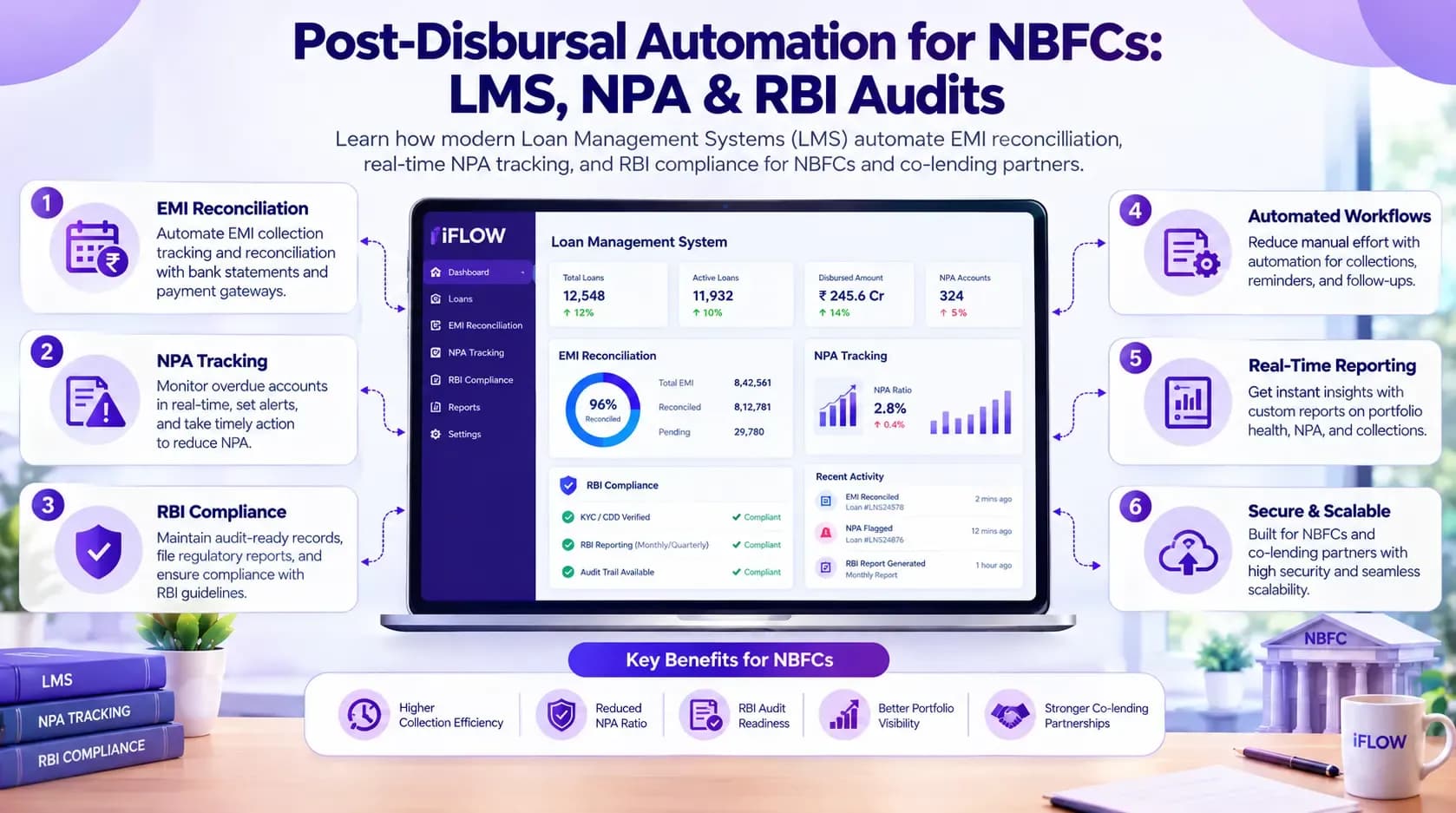
Post-Disbursal Automation for NBFCs: Automating NPA Tracking, EMI Reco, and RBI Audits
Post-disbursal automation is the software-driven execution of loan operations after funds leave the lender's account. Instead of using manual spreadsheets, a modern Loan Management System (LMS) automatically handles repayment collections via e-NACH/UPI, reconciles daily EMIs, runs automated SMA-0/1/2 and NPA classification under Reserve Bank of India (RBI) directions, routes escrow splits for co-lending partners, and issues digital NOCs upon loan closure.
Introduction
Originating a loan gets all the attention, but servicing that loan is where Non-Banking Financial Companies (NBFCs) protect their profit margins.
When your portfolio grows from a few hundred loans to tens of thousands, post-disbursal operations quickly become a major operational drag. Manual EMI reconciliation delays ledger updates. Delayed default tracking turns small collection hiccups into full-blown non-performing assets (NPAs). On top of that, strict regulatory audits from the RBI mean excel-based accounting is a direct compliance risk.
While Loan Origination Systems (LOS) focus on customer acquisition and credit scoring, your Loan Management System (LMS) carries the long-term operational weight.
Here is how modern post-disbursal LMS engines automate NPA tracking, EMI reconciliation, and audit compliance and why fixing these back-office workflows protects your balance sheet.
1. Automated EMI Reconciliation and Repayment Processing
In a traditional setup, handling daily EMI repayments requires ops teams to download bank statements, cross-reference transaction IDs against borrower accounts, and manually flag failed payments. This creates a multi-day processing gap where your ledgers do not reflect real-time financial health.
A modern LMS connects directly to payment gateways, e-NACH networks, and UPI AutoPay via webhooks. The moment a payment hits your bank account, the system reads the transaction metadata and instantly updates the borrower’s ledger.
Key Operational Benefits:
- Zero-Lag Clearing: Eliminates the T+3 or T+5 ledger updates caused by manual batch files.
- Smart Retry Protocols: When an e-NACH presentation bounces due to insufficient funds, the LMS triggers automated retry schedules based on pay-day patterns rather than arbitrary collection attempts.
- Multi-Channel Settlement: Automatically categorizes repayments coming in through different channels whether debit card, UPI, wire transfer, or collection agency deposits into a single ledger.
2. Automated NPA Classification and Early-Warning Risk Rules
The RBI mandates strict Income Recognition, Asset Classification, and Provisioning (IRACP) norms for NBFCs. Waiting for end-of-month accounting to spot overdue accounts leads to surprise defaults and unexpected provisioning charges. An enterprise LMS continuously runs background jobs that track overdue accounts day by day, automatically moving loans through overdue stages without manual data entry:
- Standard Account (0 Days Overdue): Healthy account operating under normal terms.
- SMA-0 Bucket (1 - 30 Days Overdue): Triggers soft collection SMS and WhatsApp reminders.
- SMA-1 Bucket (31 - 60 Days Overdue): Assigns case to field collection agent automatically.
- SMA-2 Bucket (61 - 90 Days Overdue): Restricts further top-up loans and alerts internal risk teams.
- NPA Classification (90+ Days Overdue): Triggers automatic loan loss provisioning per regulatory rules.
Why Automated Risk Tracking Matters:
- Real-Time Provisioning Visibility: Risk teams see exact provisioning exposure every day instead of receiving a shock at quarter-end.
- Early Warning Signals (EWS): The system flags subtle stress signals such as a borrower who consistently pays 5 days late or experiences payment bounces allowing teams to reach out before the account turns into an NPA.
- Synchronized Default Reporting: For co-lending partnerships, when an account touches default thresholds, the LMS notifies the partner bank's system automatically.
3. Co-Lending Servicing and Escrow Ledger Syncing
Co-lending has moved well beyond Priority Sector Lending (PSL) into mainstream personal, housing, and MSME finance. Under current co-lending guidelines, NBFCs and partner banks jointly fund loans (with the originating NBFC keeping a minimum 10% risk share) while presenting a single interface to the borrower.
Servicing a co-lent portfolio manually is messy. The borrower pays one single EMI, but that money has to be split across two balance sheets, two interest engines, and an escrow account.
An automated LMS manages this split effortlessly:
- Blended Rate Split Calculations: Calculates interest and principal splits accurately based on pre-agreed master sharing arrangements.
- Escrow Settlement Routing: Directs incoming collections to the escrow account and initiates partner transfers within required timelines.
- Dual-Ledger Reconciliation: Keeps both bank and NBFC systems synchronized on balance reductions, interest accruals, and partial prepayments without requiring manual file uploads.
4. Audit-Ready RBI Compliance and Automated Digital Closures
During regulatory audits, inspectors check whether your asset tags, interest accruals, and collection entries carry clear audit trails. System logs generated by a compliant LMS provide proof of every action taken on a loan file.
When a borrower pays off their last EMI, an automated LMS runs a final reconciliation check, marks the balance as zero, generates an e-NOC (No Objection Certificate), and schedules the hypothecation release instantly.
Conclusion
Lending operations do not end at disbursal; they simply enter a long, high-frequency management phase. Continuing to handle repayment reconciliations, NPA tracking, and regulatory reporting on legacy systems or spreadsheets caps your operational growth and exposes your company to compliance penalties.
Upgrading to an automated, cloud-native Loan Management System turns your back-office into a scalable growth engine. By shortening reconciliation times, catching asset quality issues early, and keeping every ledger audit-ready, your team can scale loan volume without increasing operational cost.
Frequently Asked Questions (FAQs)
Q - What is the difference between an LOS and an LMS?
A Loan Origination System (LOS) manages the pre-disbursal stage of a loan, including borrower sourcing, KYC verification, document uploads, and credit underwriting. A Loan Management System (LMS) manages the post-disbursal stage, including EMI collections, interest calculation, overdue tracking, asset classification, and loan closure.
Q - How does an automated LMS handle RBI NPA classification norms?
The LMS tracks repayment due dates continuously. If a payment is missed, it automatically categorizes the account into SMA-0 (1-30 days overdue), SMA-1 (31-60 days overdue), SMA-2 (61-90 days overdue), or NPA (90+ days overdue). This ensures daily asset tracking and accurate loss provisioning without relying on manual batch calculations.
Q - Can an LMS manage co-lending partnerships automatically?
Yes. Modern LMS platforms integrate via APIs with partner banks and escrow systems. When a borrower pays a single EMI, the LMS automatically splits the principal and interest according to the agreed ratio (e.g., 80:20), routes funds to the respective ledgers, and keeps both institutions aligned on asset quality.
Q - How does post-disbursal automation improve collection efficiency?
Automation reduces manual tracking delays. The LMS triggers instant payment reminders over SMS and WhatsApp, executes automated retry attempts for failed e-NACH presentations, and instantly routes delinquent accounts to collection teams based on overdue thresholds.