
RBI Co-Lending Arrangements Directions, 2025: What NBFCs and Banks Need to Know
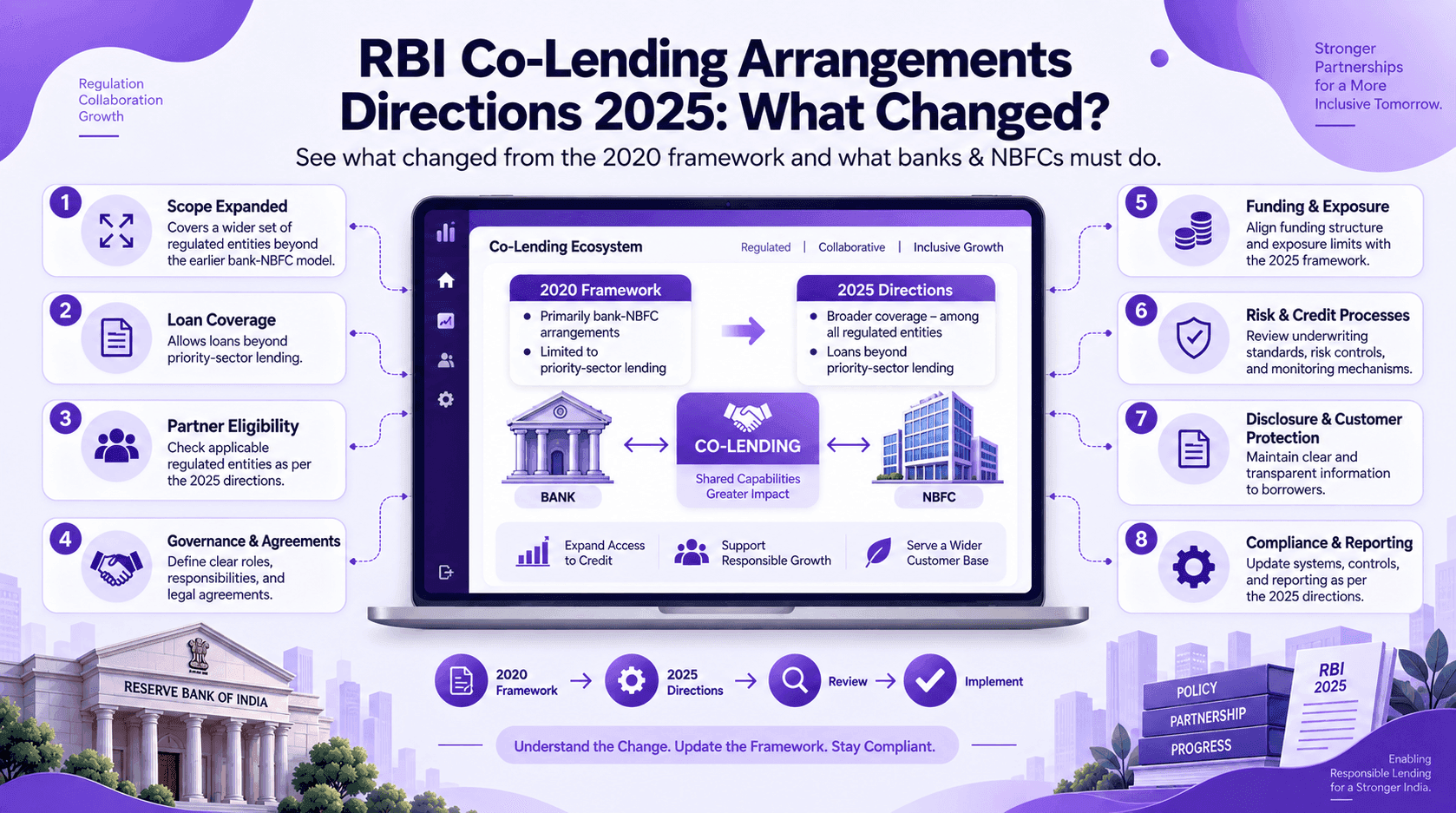
RBI’s Co-Lending Arrangements Directions, 2025 were issued on 6 August 2025 and take effect from 1 January 2026, replacing the 2020 co-lending circular. The new rules widen who can co-lend, require each lender to retain at least 10% of every loan, make a blended interest rate mandatory for the borrower, and set a 15-day window to move funds between the bank and NBFC. Any new co-lending arrangement signed on or after 1 January 2026 has to follow these rules.
Introduction
For a few years, co-lending in India ran mostly on RBI’s 2020 circular, which was fairly narrow. It focused on banks lending to priority-sector borrowers alongside NBFCs, and left a fair bit to individual agreements between partners.
That changed on 6 August 2025, when RBI issued the Co-Lending Arrangements Directions, 2025. These take effect from 1 January 2026 and apply much more broadly, to more types of lenders, more types of loans, and with tighter, clearer requirements than before.
If your bank or NBFC is already in a co-lending partnership, or planning one, here is what actually changed and what you need to check before the new rules kick in.
Who Do the New Rules Apply To?
The 2025 Directions apply to a much wider group of lenders than the old 2020 circular did. They cover all Commercial Banks (excluding Small Finance Banks, Local Area Banks, and Regional Rural Banks), all NBFCs including Housing Finance Companies, and All India Financial Institutions such as NABARD, SIDBI, and NaBFID. This last group, AIFIs, is new. They were not covered under the earlier framework.
The rules also move beyond priority-sector lending, which was the main focus of the 2020 circular. Co-lending under the 2025 framework can now happen across a broader range of loan types, not just priority-sector loans.
One thing the Directions clearly exclude: loans structured as multiple banking, consortium lending, or syndication. If you want to understand exactly how those differ from co-lending, we cover that in co-lending vs loan syndication vs loan assignment.
What Actually Changed From the 2020 Rules
1. Minimum Retention Is Now 10% for Every Lender
Each regulated entity in the arrangement, both the originating and the partner lender, must retain a minimum of 10% of every individual loan on its own books. This applies to both sides now, not just the NBFC, and it ensures neither lender can fully offload its risk while still calling it co-lending.
2. A Blended Interest Rate Is Mandatory
The borrower is charged a single interest rate, calculated as a weighted average of what each lender charges based on their share of the loan. If either lender changes its rate, the blended rate has to be recalculated and disclosed again. This replaces the more flexible, less standardised rate-setting that existed under the 2020 circular.
3. Funds Must Move Within 15 Days
The Directions set a clear 15-calendar-day window for transferring funds between the bank and the NBFC for each loan. This is a concrete, checkable requirement, and it is one of the things an audit is likely to look at directly.
4. A Key Facts Statement Is Required
Borrowers must be given a Key Facts Statement that discloses each lender’s funding share, the applicable rate and charges, who is responsible for servicing the loan, and how to raise a complaint. All fees also need to be reflected in the Annual Percentage Rate shown to the borrower.
5. An Escrow Account Is Required for Fund Flows
Money moving between the bank and the NBFC for each borrower has to pass through an escrow account, so funds from different loans and different partners are not mixed together.
6. Selective Loan Purchase No Longer Counts as Co-Lending
Under the old rules, a bank could review and select which loans from an NBFC’s pool it wanted to fund, effectively cherry-picking after origination. The 2025 Directions do not carry this forward as part of co-lending. A bank picking loans out of an already-originated pool now falls under RBI’s separate loan transfer and assignment rules instead.
What This Means for NBFCs and Banks Right Now
If you are an NBFC or a bank already running a co-lending partnership, or planning to start one, a few things are worth checking before 1 January 2026:
- Whether your current technology can calculate a blended rate automatically, rather than manually
- Whether your systems track the 10% retention requirement for both partners, not just one
- Whether fund transfers between partners are timestamped and can be proven to fall within 15 days
- Whether your borrower-facing disclosures already include everything the new Key Facts Statement requires
- Whether your credit policy has been updated to reflect exposure limits, borrower segmentation, and partner due diligence under the new framework
Older platforms built for the 2020 rules are unlikely to handle all of this automatically. We go through what to actually check in a platform in how to choose a co-lending platform.
Quick Reference: 2020 Circular vs 2025 Directions
2020 Circular 2025 Directions Who can participate Banks and NBFCs, priority sector focus Commercial banks, AIFIs, and all NBFCs, wider scope Minimum retention 20% for the NBFC 10% for each lender Interest rate Flexible, agreement-based Mandatory blended rate, weighted average Fund transfer timeline Not strictly defined 15 calendar days Selective loan purchase Allowed Not treated as co-lending Effective date 2020 1 January 2026
Conclusion
RBI’s Co-Lending Arrangements Directions, 2025 are not a minor update. They widen who can co-lend, tighten retention requirements on both sides, and add concrete, checkable requirements like the blended rate and the 15-day fund transfer window. For banks and NBFCs already in co-lending partnerships, the practical work now is making sure systems and policies are actually ready for 1 January 2026, not just aware of it. At iFLOW, this is exactly the kind of compliance groundwork we help lenders get in place before the deadline.
FAQs
Q - When do RBI’s Co-Lending Arrangements Directions, 2025 take effect?
They were issued on 6 August 2025 and take effect from 1 January 2026, or earlier if a lender chooses to adopt them sooner under its own internal policy.
Q - What is the minimum retention requirement under the new rules?
Each lender involved in a co-lending arrangement, both the originating and the partner entity, must retain at least 10% of every individual loan on its own books.
Q - Do the 2025 Directions apply to loan syndication or consortium lending?
No. The Directions specifically exclude loans structured as multiple banking, consortium lending, or syndication arrangements.
Q - What happens to co-lending arrangements signed before 1 January 2026?
Existing arrangements can continue as agreed, but any new co-lending arrangement entered into on or after the effective date must comply with the 2025 Directions.
Q - What is a blended interest rate in co-lending?
It is a single interest rate charged to the borrower, calculated as a weighted average of each lender’s individual rate based on their share of the loan. Want to see a platform already built for the 2025 rules? Book a demo with iFLOW.