
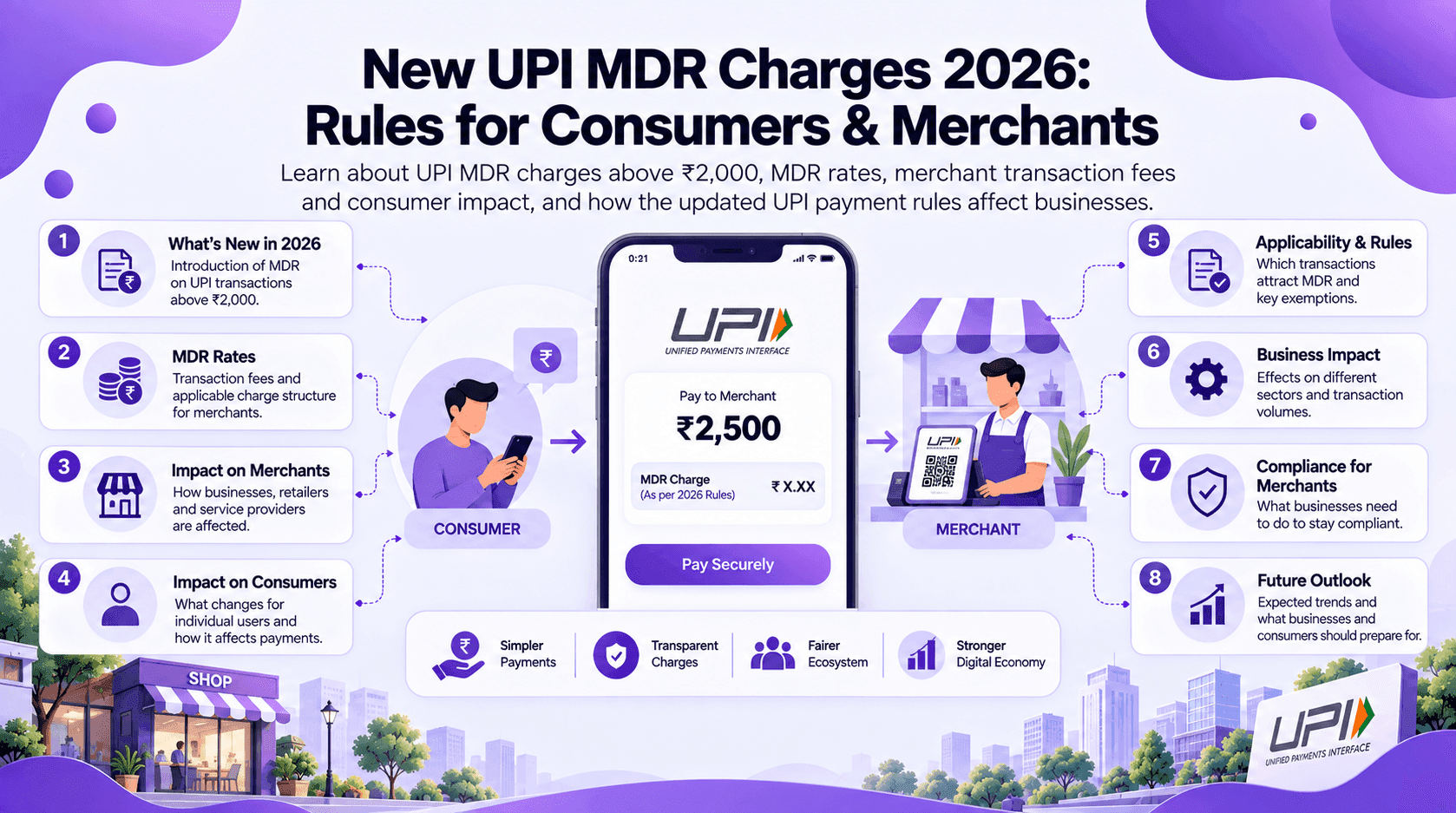
Understand UPI MDR Charges: New Rules and Changes for 2026 in India
What Are the New UPI MDR Charges From 15 October 2026?
-
UPI MDR Charges will apply to eligible merchant payments above ₹2,000 from 15 October 2026, at 0.4% per transaction, with a maximum charge of ₹300.
-
Customers won’t have to pay the MDR.
-
P2P UPI transfers and eligible payments up to ₹2,000 remain free.
-
Small merchants under the P2PM category are also exempt.
-
Merchants cannot add the MDR to the customer's bill or recover it as a separate charge.
Note: The new MDR applies to eligible merchant transactions above ₹2,000; UPI remains free for customers.
Introduction
For years, UPI has been free for merchants. That is a big reason it spread so fast, from tea stalls to large online stores. On 15 September 2026, the government and NPCI announced that this is changing for some payments.
From 15 October 2026, some higher-value UPI payments to merchants will carry a small fee. For most users, this won’t make much difference because more than 95% of merchant payments are ₹2,000 or below and will remain free.
If you run a business, handle payments, or build lending and collections systems, here is what actually changes, what does not, and what to check before the date.
What Is MDR on UPI?
MDR stands for Merchant Discount Rate. It is a small fee for processing a payment made to a merchant. The merchant pays it, not the customer, and it is shared among the banks and payment companies that make the transaction work.
Under the new framework, the money collected is meant to go back into the UPI system itself, for things like infrastructure, security, fraud detection and customer service. It is not a tax. It is not collected by the government or NPCI.
Is UPI Still Free in 2026?
For customers, yes. For merchants, it depends on the type and size of the payment.
Person-to-person (P2P) payments
stay free, whatever the amount. This includes sending money to family and friends, splitting a bill, and transferring between your own accounts.
Customers paying merchants
still pay nothing extra. You pay the listed price. UPI apps are also barred from adding any platform fee.
UPI AutoPay
(recurring payments like utility bills, OTT plans and mutual fund SIPs) does not carry the prescribed MDR.
UPI MDR Charges From 15 October 2026
Here is the full picture in one place.
| Type of payment | MDR |
|---|---|
| P2P transfers (including self-transfers) | No MDR |
| Payments to merchants up to ₹2,000 | No MDR |
| Payments to merchants above ₹2,000 | 0.4% |
| Payments of ₹75,000 and above | Capped at ₹300 |
| Railways, telecom, insurance, fuel and similar sectors, above ₹2,000 | Flat ₹5 |
| Capital market payments (mutual funds, brokers) | 0.02%, max ₹300 |
| Small merchants under P2PM (up to ₹1 lakh a month via QR) | No MDR |
| UPI AutoPay mandates | No MDR |
| Credit-linked UPI (like RuPay credit card or credit line on UPI) | Follows separate credit product rules |
One detail that trips people up: the fee applies to payments above ₹2,000. A payment of exactly ₹2,000 has no MDR.
How Much Will It Cost? A Few Quick Examples
- ₹3,000 payment: 0.4% is ₹12
- ₹50,000 payment: 0.4% is ₹200
- ₹1,00,000 payment: 0.4% would be ₹400, but the cap applies, so the fee is ₹300
Small numbers on their own. Across thousands of payments a month, though, they add up, and that is where tracking matters.
Who Pays UPI MDR: Merchants or Customers?
Merchants pay it. Customers do not.
Merchants are not allowed to pass MDR on to customers as an extra charge, and UPI apps cannot add platform fees. A customer scanning a QR code at a shop pays only the price on the tag.
What About Small Merchants?
Small merchants stay protected. Vendors under the P2PM category, who receive up to ₹1 lakh a month through UPI QR codes, continue with zero MDR. They do not need GST registration to qualify, and they do not need to change their existing QR codes or soundboxes.
There is one thing to watch. If a merchant receives more than ₹1 lakh a month through UPI for three months in a row, they move from the P2PM category to the regular P2M category.
A separate fund is also planned to help small merchants in smaller towns and rural areas with onboarding and incentives. The framework for it is expected to be finalised with the RBI within three months.
Why Was MDR Introduced on UPI?
Running UPI at this scale is expensive. In August 2026 alone, UPI handled 2,451 crore transactions worth ₹29.9 lakh crore. Industry estimates put the yearly cost of running the system, including servers, fraud prevention and bank support, at around ₹20,000 crore.
Government incentives helped UPI grow in its early years, but they were meant as short-term support. The new fee is meant to give banks and fintech companies steady funding for security and upgrades, without charging everyday users.
How Does UPI MDR Work?
A merchant payment looks simple to the customer, but a few players are involved behind the scenes:
Customer → UPI app → Payment service provider → Acquiring bank → Merchant
Here is what happens in that flow:
-
The customer scans a QR code or enters an amount in their UPI app and approves the payment with their PIN.
-
The payment is routed through the payment infrastructure, which checks and validates it.
-
The customer’s account is debited and the merchant’s account is credited through the acquiring bank.
-
The payment is confirmed and settled, and the record is kept for disputes and reconciliation.
MDR sits inside this flow, on the merchant side. For an applicable payment, the merchant pays the MDR to its acquiring bank. It is then shared only within the UPI ecosystem, among the banks and payment companies that make the payment work. The customer sees none of this and pays only the listed price.
UPI MDR vs Card Charges
UPI is still much cheaper than cards for merchants.
| Payment method | Typical merchant charge |
|---|---|
| UPI (above ₹2,000) | 0.4%, capped at ₹300 |
| Debit cards | Up to 0.90% |
| Credit cards | Around 1.5% to 2.5% |
So while UPI is no longer free for every merchant payment, it remains the lowest-cost digital option for most businesses.
What Should Businesses Do Before 15 October?
A few practical steps make the change much easier to handle.
1. Check which of your payments are affected
Sort your UPI volume by amount and category. Anything at ₹2,000 or below is unaffected. Fuel, insurance, telecom and similar sectors may fall under the flat ₹5 fee.
2. Verify with your bank/payment processor
Clarify how MDR will appear in your settlement statements, and if the MDR will be taken at source or charged separately.
3. Be stricter with reconciliations
Since settlement amounts will be different from payment amounts on transactions, the system needs to reconcile the payments to settlements, bank entries, and accounting entries to prevent large reconciling differences.
4. Maintain detailed transaction information
Detailed information will help in identifying any failures, reversals, refund, or MDR adjustments.
5. Always rely on official information
There are lots of rumors around UPI charges. Verify all such information from the Ministry of Finance, RBI, and NPCI.
What This Means for Lenders, Banks and Fintechs
If you collect EMIs, disburse loans or run payment flows, this change touches your reconciliation and cost reporting. UPI AutoPay mandates, which many lenders use for recurring repayments, do not carry the prescribed MDR. For other collection flows, it is worth confirming with your acquiring bank or payment provider how each one is classified.
This is also why more lenders are moving to API-orchestrated payment and collections flows, where payment confirmation, settlement and repayment matching happen automatically instead of by hand. The same discipline sits behind a well-run loan management system, where every collection and disbursement is tracked at the transaction level.
Final Thought About UPI MDR Charges in 2026
UPI is not yet a paid system for all transactions. As of 15 October 2026, fees apply only on certain merchant transactions exceeding ₹2,000, and all other daily transactions and P2P transactions remain free. In this case, the right strategy for businesses is not to shun away from UPI but to identify the transactions that fall under the category and measure the costs.
At iFLOW, we help lenders and financial platforms connect loan origination system, disbursement, collections and reconciliation into one clear system, so changes like this are easy to absorb.
Frequently Asked Questions on UPI MDR Charges
1. Is UPI free in 2026?
UPI stays free for customers and for all P2P transfers. Merchant payments up to ₹2,000 and payments to eligible small merchants are also free. From 15 October 2026, MDR applies to specified merchant payments above ₹2,000.
2. What are the UPI charges from 15 October 2026?
A 0.4% MDR applies to specified UPI payments to merchants above ₹2,000, capped at ₹300 for payments of ₹75,000 and above. Some sectors like railways, telecom, insurance and fuel pay a flat ₹5. Capital market payments carry 0.02%, with a maximum of ₹300.
3. Do customers have to pay UPI MDR?
No. MDR is a merchant-side charge. Merchants cannot pass it on to customers, and UPI apps cannot charge platform fees.
4. Is UPI MDR charged on payments of ₹2,000 or less?
No. Payments up to ₹2,000 carry no MDR. The fee starts only on payments above ₹2,000.
5. Are small merchants affected by UPI MDR?
No. Small merchants under the P2PM category, receiving up to ₹1 lakh a month through UPI QR codes, continue to get zero MDR. If they cross ₹1 lakh a month for three months in a row, they move to the regular merchant category.
6. Does UPI AutoPay have MDR?
No. UPI AutoPay mandates, used for recurring payments like bills, OTT subscriptions and SIPs, do not carry the prescribed MDR.
7. Will UPI become chargeable for individuals?
No. P2P transfers remain free for both sender and receiver, including self-transfers.
8. Why was MDR introduced on UPI?
To give the UPI system steady funding for infrastructure, security and innovation, without charging everyday users or small merchants.