
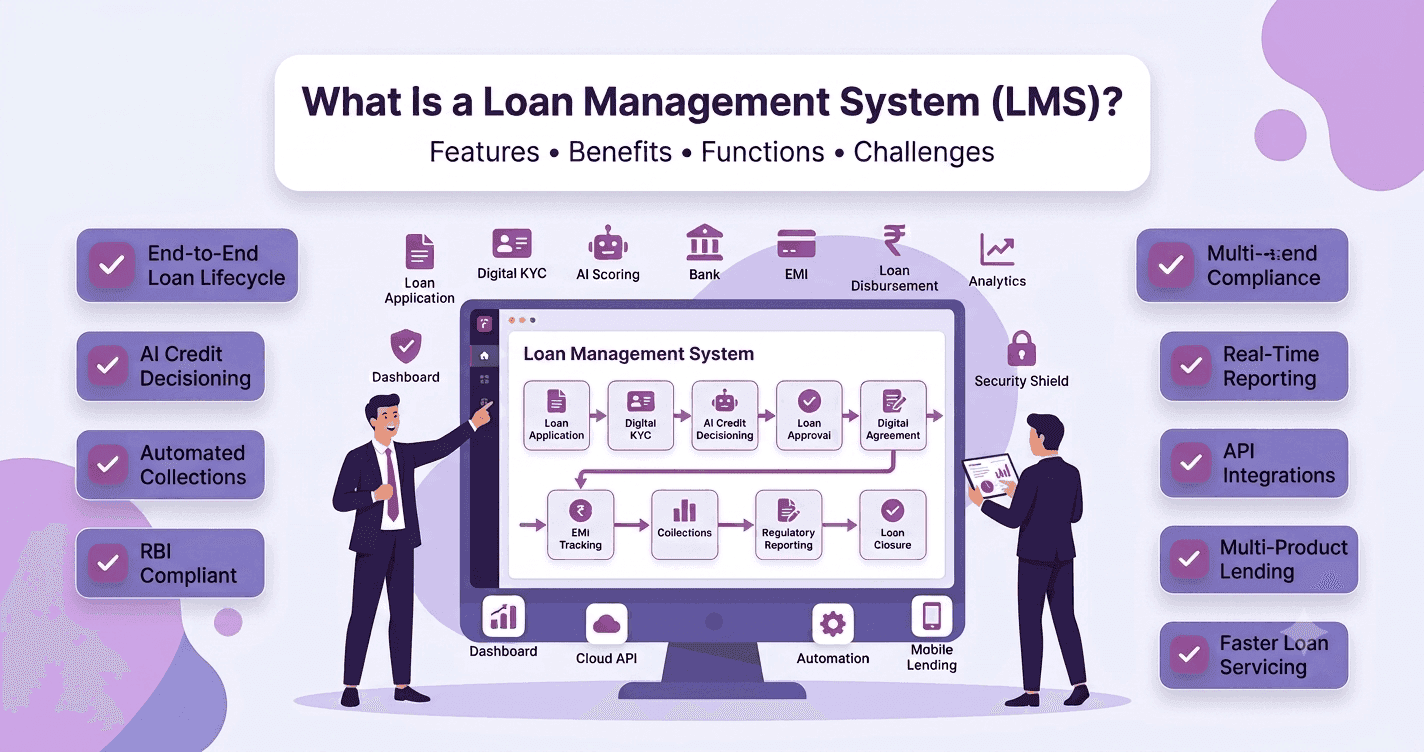
What Is a Loan Management System (LMS)? Features, Benefits, Functions & Challenges
A loan management system (LMS) is software that handles the complete life of a loan. It starts when a borrower fills out an application and does not stop until the loan is fully paid off or closed. In between, it takes care of KYC, underwriting, disbursement, EMI tracking, collections, and regulatory reporting all in one place.
Banks, NBFCs, fintechs, and co-lending platforms use an LMS to manage everything from credit decisioning to NPA classification under one roof, instead of juggling spreadsheets, emails, and disconnected tools.
Introduction
Running a lending business without proper software is like managing a hundred bank accounts on paper. At some point, things start slipping through the cracks. A borrower misses a payment. Someone makes an interest calculation error. A compliance deadline sneaks up. And before you know it, what was a manageable problem becomes an expensive one.
Most lenders start out with spreadsheets and a patchwork of tools. It works for a while, but as loan volumes grow, that approach starts to break down quickly.
A loan management system is what lenders use to get out of that situation. It brings all your loan data, workflows, and reporting under one roof, so your team spends less time firefighting and more time actually running the business.
This guide walks you through everything: what an LMS actually does, how it works step by step, how it compares to a Loan Origination System (LOS), what features to look for, and why the Indian lending market has its own set of requirements that generic platforms often miss.
What Is a Loan Management System (LMS)?
A Loan Management System, is software built specifically for lenders. It tracks and manages every stage of a loan, from the day a borrower applies to the day the loan is fully repaid or written off.
What makes it different from a regular CRM or accounting tool is that it understands lending logic. It knows how to calculate daily interest accruals, apply prepayment penalties, classify accounts as NPA after 90 days of non-payment, and generate the kind of reports a regulator actually wants to see.
At its core, an LMS helps lenders in three key ways:
- It keeps all your loan data in one place, so there is no more hunting across spreadsheets and email threads.
- It automates the repetitive stuff, so your team can focus on decisions rather than data entry.
- It applies your business rules consistently across every loan, every time, without exceptions.
Everything else in your lending stack, KYC providers, credit bureaus, payment gateways, accounting software, connects into the LMS. It is the central system that ties everything together.
Who Uses a Loan Management System?
- Banks
- NBFCs
- Digital lenders
- Fintech companies
- Microfinance institutions
- Co-lending partners
- Credit unions
How Does a Loan Management System Work?
The best way to understand what an LMS does is to follow a loan from start to finish and see what happens at each stage.
Step 1. Application and Onboarding
The borrower fills out an application on a website, mobile app, or through an agent. The LMS captures all the data, triggers KYC verification through Aadhaar, PAN, or DigiLocker, and also supports Video KYC (V-CIP) which RBI has mandated for digital lenders. It pulls credit reports from bureaus like CIBIL or Experian and checks that all required documents are in order. Your team does not have to manually re-enter anything.
Step 2. Credit Assessment
The system runs the application through a credit policy engine or an AI scoring model. It looks at bureau scores, income details, repayment history, and any other data points your policy requires. Within seconds, it produces a credit decision: approve, reject, or send to manual review. Every decision is logged with the reasons behind it.
Step 3. Sanction and Agreement
For approved loans, the LMS automatically generates the sanction letter, repayment schedule, and loan agreement. The borrower signs digitally through an e-sign workflow. All documents are stored inside the loan account and tied to the borrower's record.
Step 4. Disbursement
The funds go out through NEFT, IMPS, or UPI, depending on what the borrower prefers. The LMS reconciles the transfer automatically against the loan account, so your finance team does not have to match payments manually at the end of the day.
Step 5. Repayment and Servicing
Once the loan is live, the LMS tracks every EMI, partial payment, prepayment, and interest accrual in real time. The loan ledger updates automatically. Borrowers can log into a self-service portal to check their outstanding balance, review past transactions, or see when their next payment is due.
Step 6. Collections
When a payment is missed, the LMS does not wait for someone to notice. It automatically segments overdue accounts by days past due and sends reminders through SMS, WhatsApp, email, or an IVR call. Accounts that do not respond get escalated to collection agents or field teams based on rules you set in advance.
Step 7. Closure and Reporting
When the loan is fully repaid, the LMS closes the account, issues a No Dues Certificate, and updates the ledger. Any regulatory reports, whether NPA statements, ageing analysis, or audit logs, are generated directly from the system data. No manual compilation required.
What Is the Difference Between LMS and LOS?
A Loan Origination System (LOS) manages loan applications and approvals, while a Loan Management System (LMS) manages repayments, servicing, collections, and post-disbursement operations.
A lot of lenders use these terms interchangeably, but they are two different systems that serve two different purposes. The simplest way to tell them apart is by where in the loan journey they are active.
| Aspect | Loan Origination System (LOS) | Loan Management System (LMS) |
|---|---|---|
| What it does | Handles the loan before it is approved: application, underwriting, credit decision | Handles the loan after it is approved: repayment, servicing, collections, closure |
| Core question it answers | Should we give this person a loan? | How is this loan performing right now? |
| Who uses it | Credit analysts, underwriters, sales teams | Operations, collections, finance, and compliance teams |
| When it is active | Only during the origination phase | Across the full loan lifecycle, including after closure |
| Key outputs | Credit decisions, sanction letters, loan agreements | Repayment schedules, NPA reports, collection queues, audit trails |
| How they connect | The LOS hands the loan over to the LMS at disbursement | The LMS is the central hub that integrates with LOS, payments, and accounting |
Many modern platforms, including iFLOW, combine both into a single system. That way, there is no handoff between two separate tools, no data mismatch at disbursement, and no duplication of borrower records.
Key Functions of a Loan Management System
An LMS is not just a place to store loan data. It actively runs large parts of your lending operations. These are the core things it handles on a daily basis.
Borrower Onboarding and KYC
It captures borrower information, verifies identity through government databases like Aadhaar and DigiLocker, pulls credit bureau reports, and stores all documents securely. When onboarding is smooth and fast, fewer borrowers drop off mid-application.
Loan Product Configuration
It manages the rules for every loan product you offer. Whether it is a personal loan with a flat interest rate, a business loan with a reducing balance, or a BNPL product with a grace period, all the product logic lives here and can be adjusted without touching code.
Credit Decisioning
It applies your credit policy to every application. Whether you use a rule-based engine, an AI model, or a combination of both, every decision is consistent, explainable, and logged for compliance purposes.
Disbursement and Reconciliation
It triggers fund transfers through your connected payment infrastructure and reconciles them automatically. Your finance team no longer has to cross-check bank statements against loan accounts every morning.
Loan Servicing and Ledger
It maintains the live financial record for every loan: principal outstanding, accrued interest, fees collected, prepayments received, and any charges applied. Every entry is timestamped and cannot be altered after the fact, which matters enormously during audits.
Collections and Recovery
It automates everything from the first overdue reminder to field visit scheduling and legal escalation. Your collections team gets a clean queue of accounts to work, with full history visible on every borrower.
Compliance and Regulatory Reporting
It generates the reports your regulators need for NPA statements, ageing analysis, vintage reports, and audit logs. For lenders in India, this means formats that the RBI actually accepts, not something you then have to reformat manually.
Account Aggregator and NACH Integration
For Indian lenders, both have moved from optional to essential. Account Aggregator (AA) connectivity lets borrowers share verified bank statements and financial records directly with the lender, no physical documents needed. NACH handles mandate registration and automated EMI deductions through NPCI. An LMS with both built in means your team is not dependent on workarounds every time a mandate fails or a borrower needs to share financial data.
Key Features to Look For in a Loan Management System
When you are evaluating LMS options, the feature list can feel overwhelming. Here is what actually matters and why.
-
No-code workflow editor Your operations team should be able to change a collection rule or add a new fee type without filing a ticket with your tech team. If they cannot, every small change becomes a project.
-
API-first architecture You need to connect to CIBIL, a KYC provider, a payment gateway, and your accounting software. A system with pre-built connectors gets you to live in weeks, not months.
-
Configurable rule engine Interest rates, late fees, overdue triggers, and escalation logic should all be things you can change yourself. A vendor who hardcodes these things will slow you down every time your policy changes.
-
Real-time dashboards You should be able to see your NPA percentage, DPD distribution, and collection efficiency at any point during the day, not just after someone pulls a month-end report.
-
Role-based access control A collection agent should not be able to see credit underwriting data. A sales manager should not be able to modify loan terms. Proper access controls are a basic compliance requirement.
-
Full audit trails Every action in the system should be logged with a timestamp, a user ID, and a before-and-after record. Without this, a regulatory inspection becomes very uncomfortable.
-
Multi-product and multi-branch support If you offer more than one loan product or operate in more than one location, you need a single system that covers all of it, not separate tools for each.
-
Borrower self-service portal When borrowers can check their balance, download a statement, or make a payment on their own, your support team handles far fewer inbound calls.
-
Mobile-ready interface Your collection agents and field teams work on phones. The system needs to work just as well on a mobile screen as it does on a laptop.
-
AI-Based Credit Decisioning Uses predefined rules and AI models to assess borrower risk, automate credit evaluations, and support faster, more accurate lending decisions.
-
Co-Lending Management Helps lenders and partner institutions manage shared loans, automate fund allocation, track repayments, and simplify reconciliation throughout the loan lifecycle.
Benefits of a Loan Management System
Here is what changes in practice after a lender moves to a proper LMS.
| What improves | What it looks like in practice |
|---|---|
| Faster disbursements | Automated KYC, instant credit decisions, and connected payment rails can take time-to-disburse from days down to a few hours |
| Lower cost to serve each loan | When routine tasks run automatically, the same team can manage a much larger loan book without burning out |
| Better collection rates | Structured, automated follow-ups with the right channel at the right time recover more money than manual calling ever did |
| Cleaner compliance | Timestamped logs and automated reports take the stress out of regulatory inspections |
| Live portfolio visibility | Seeing your NPA and DPD numbers in real time means you can respond to problems early instead of discovering them at month-end |
| Happier borrowers | Faster approvals, digital repayment options, and a self-service portal make a real difference to the borrower experience |
| Room to grow | When you launch a new product or open a new branch, you add it to the same system instead of building something from scratch |
| Fewer costly errors | Automated calculations mean nobody ever applies the wrong interest rate or miscalculates a prepayment penalty |
Challenges in Loan Management and How an LMS Solves Them
Most lenders who come to us have run into at least one of these problems. Here is what they look like without an LMS, and what changes when you have one.
| The problem | Without an LMS | With an LMS |
|---|---|---|
| Data is everywhere | Borrower records are split across spreadsheets, emails, and old systems with no single source of truth | Everything lives in one system, with a full history attached to every loan and every borrower |
| Collections are inconsistent | Follow-ups depend on who remembered to call, recovery rates are low, and there is no audit trail | Automated segmentation by DPD, structured outreach across channels, every action logged |
| Regulatory changes cause panic | Policy changes mean manually updating spreadsheets, templates, and processes across the whole team | Change the rule once in the system and it applies to every loan from that point forward |
| No visibility until month-end | By the time you see a problem in a report, it has already gotten worse | Real-time dashboards let you spot rising DPD or NPA formation as it happens |
| Integrations keep breaking | Every connection to a bureau, payment gateway, or KYC provider was custom-built and needs constant maintenance | Pre-built connectors maintained by the vendor, so you are not stuck fixing broken APIs |
| Calculation errors are costing money | Someone applies the wrong rate, misses a fee, or gets a prepayment amount wrong | Automated calculations run on configured rules, the same way, every time, for every loan |
Why Do Lenders Need an LMS in 2026?
Lenders who have been getting by without one are finding it harder to keep up. Three things in particular are making this feel urgent right now.
Regulators are asking for more
RBI has tightened norms significantly over the last couple of years. Digital lending guidelines, Key Fact Statement requirements, co-lending rules, and data localization are not optional. Keeping up with all of this manually, across a growing loan book, is not realistic. A system with compliance built in is the only way to stay ahead of it without growing your compliance team every time rules change.
Borrowers expect a different experience now
Someone applying for a loan in 2026 expects to get a decision quickly, receive money the same day, and manage their account from their phone. If your process takes three days and requires them to come into a branch, you are losing borrowers to lenders who can do it in three hours. Speed is no longer a differentiator. It is a baseline expectation.
The competition has moved fast
Digital lenders who built on modern stacks a few years ago are now operating at a cost per loan that traditional lenders cannot match with manual processes. The gap is not closing on its own. The lenders who close it do so by automating their operations, and an LMS is the primary tool for doing that.
Co-lending is scaling fast
RBI's co-lending framework has pushed more NBFCs into bank partnerships. Managing co-lending manually split disbursements, shared repayment schedules, partner reconciliation is nearly impossible at scale without a dedicated module. Most lenders running co-lending without an LMS are losing time and money on reconciliation alone.
The Future of Loan Management Systems
The category is moving quickly. Here is where things are heading over the next few years and what it means for lenders who are evaluating systems today.
-
AI in credit decisioning is becoming standard Models that go beyond bureau scores and look at cash flow patterns, transaction behaviour, and alternative data are being used by more lenders every year. The best LMS platforms are bringing these models directly into the underwriting workflow rather than treating them as a separate tool.
-
Lending is moving inside other products More and more, loans are being originated inside accounting software, e-commerce platforms, and ERP systems. An LMS that supports embedded lending through APIs lets lenders reach borrowers where they already are, without requiring them to go to a separate portal.
-
Collections are getting smarter AI models that identify which borrowers are likely to miss a payment before they actually miss it are allowing lenders to get ahead of the problem. Early intervention costs less and recovers more than chasing overdue accounts after the fact.
-
Account Aggregator and OCEN are changing the game in India India's Account Aggregator framework and the Open Credit Enablement Network are creating new ways for lenders to access verified financial data and distribute credit at scale. Lenders whose LMS is integrated with the AA framework are going to have a significant advantage as these networks mature.
-
Regulators want real-time data The direction of travel from RBI and other regulators globally is toward real-time data submission rather than periodic reports. An LMS that can push data directly to regulatory APIs will save a significant amount of operational overhead for compliance teams.
FAQs
Q1. Do small NBFCs need a Loan Management System (LMS)?
Yes, and often more than large ones. Small NBFCs have fewer people, which means manual processes hit a ceiling faster. An LMS lets a small team manage a much larger loan book by automating the repetitive work. SaaS-based options have made it affordable for early-stage NBFCs too, with no large upfront investment required.
Q2. How long does it take to implement a Loan Management System?
A SaaS LMS with a straightforward product can be live in four to eight weeks. An enterprise implementation with complex products, multiple integrations, and data migration from legacy systems typically takes three to six months. Good vendors offer a phased rollout so you are not waiting months before you see any value.
Q3. How does an LMS help with NPA management?
It tracks days past due in real time and automatically classifies accounts as SMA-0, SMA-1, SMA-2, or NPA based on RBI norms. It sends early alerts so your collections team can act before accounts deteriorate further. Instead of finding out about a rising NPA number in a month-end report, you see it happening and can respond.
Q4. Is a cloud-based Loan Management System secure for sensitive lending data?
A well-built cloud LMS uses encryption for data in transit and at rest, role-based access controls, multi-factor authentication, and regular security testing. For Indian lenders, data residency within India is also important for RBI compliance. In many cases, a maintained cloud platform is more secure than an on-premise legacy system that rarely gets security updates.
Q5. What integrations should a Loan Management System support?
At a minimum: CIBIL and Experian for credit bureau reports, DigiLocker and NSDL for KYC, NPCI for UPI and NACH, NEFT and IMPS for disbursements, and accounting software for reconciliation. If you do secured lending, CERSAI integration matters too. GST-compliant invoice generation is another requirement that often gets overlooked until it causes a problem.
Q6. Can a Loan Management System support co-lending?
Yes, but this is something to verify carefully. A proper co-lending setup requires the LMS to handle partner bank allocation, shared repayment schedules, and split reconciliation between co-lenders. Not all platforms do this well, and finding out after go-live that it does not work the way you need is an expensive lesson. Ask for a live demo of the co-lending module specifically.
Q7. How much does a Loan Management System cost?
It varies a lot by model and scale. SaaS platforms typically charge a monthly fee or a per-loan fee, which makes them accessible without a large upfront investment. Enterprise on-premise systems involve higher licensing, infrastructure, and implementation costs. When you are comparing options, always look at the total cost including implementation, integrations, data migration, training, and ongoing support. The license cost is rarely the biggest number.
See a Loan Management System Built for Indian Lenders
iFLOW's, LMS is built specifically for NBFCs, co-lenders, and digital lending fintechs in India. It comes with RBI-compliant workflows, native India payment stack integrations, co-lending support, and a no-code workflow editor your operations team can use on day one.
The fastest way to know if it fits is a live pilot with your own loan products, not a slide deck. That is what we offer.