
What Is a Loan Origination System (LOS)? Meaning, Process, and RBI Rules for 2026
A Loan Origination System (LOS) is software that runs a loan from application through disbursal. It handles KYC, credit checks, underwriting, offer generation, and consent capture, then hands the loan off to a servicing system. Banks and NBFCs use an LOS to cut sanction time from days to minutes while keeping the audit trail that RBI's Digital Lending Directions require.
What Is a Loan Origination System (LOS)?
A Loan Origination System (LOS), or LOS, is software that manages a loan from the moment someone applies to the moment the money is disbursed. It handles KYC checks, credit checks, underwriting, and offer generation, then passes the loan on to a servicing system. Banks and NBFCs use an LOS to bring sanction time down from days to minutes, while still keeping the kind of audit trail that RBI's Digital Lending Directions now require.
The rest of this article explains how the pieces fit together, what has changed under the current RBI rules, and what actually matters when you're choosing or building one.
Why LOS Matters Right Now
Manual loan processing runs on paper files, spreadsheets, and phone calls between the credit team, the KYC vendor, and the branch. This works fine at low volume. Once you cross a few hundred applications a month, it starts to break down. Approvals slow from hours to days, the same data gets typed in again at every handoff, and if you ever need to reconstruct what happened on a loan, it turns into a research project.
That last part is no longer optional. In May 2026, RBI replaced its older digital lending rules with one consolidated framework called the Digital Lending Directions. Every bank, NBFC, co-operative bank, and housing finance company, along with any lending service provider working with them, now follows this single rulebook for consent, disclosure, and how money moves.
A further update followed on 1 March 2026, tightening the Key Fact Statement format even more. An LOS that cannot produce a clean, timestamped record of each step in the loan journey is now a compliance risk, not just an operational headache.
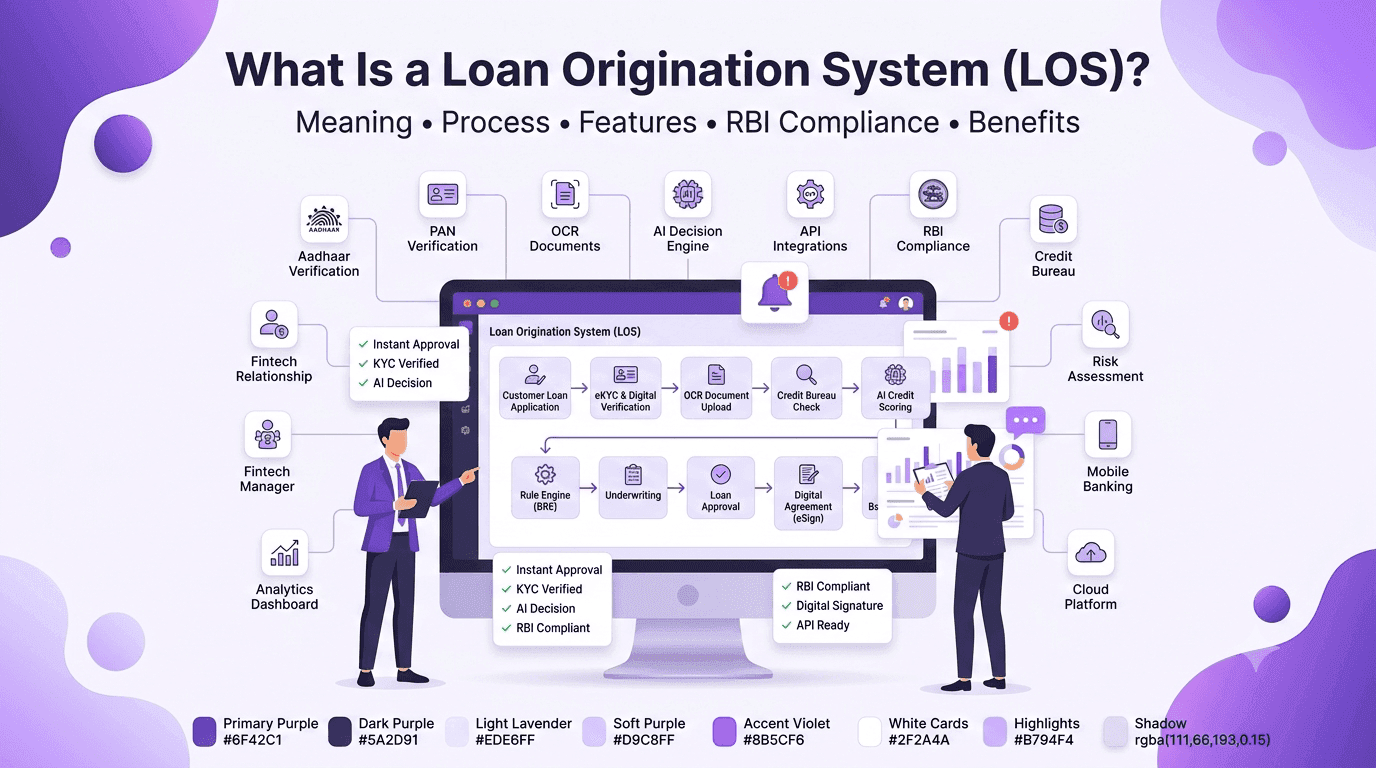
How a Loan Origination System Works
Every LOS, no matter who builds it, follows roughly the same sequence.
1. Application intake - The borrower applies through a website, app, or branch, and the system captures the lead and runs a first eligibility check.
2. Verification - This includes eKYC, video KYC, or in-branch KYC, along with document upload and OTP or biometric checks.
3.Credit assessment - The system pulls bureau data, bank statements, ITRs, GST filings, and sometimes alternative data to build a risk picture.
4.Underwriting and decisioning - Rule-based scoring approves, declines, or sends the file for manual review.
5.Offer generation - Tenure, interest rate, and EMI get set based on the loan type and the borrower's risk profile.
6.Documentation and consent - The loan agreement and Key Fact Statement are generated, signed digitally, and logged.
7.Disbursal - Funds move directly between the lender's account and the borrower's bank account, as RBI requires.
8.Audit and reporting - Every action is timestamped and logged for dashboards and regulatory reporting.
Who Should Use a Loan Origination System?
An LOS isn't only for large banks. Any lender processing real volume, or any lender that needs to reconstruct a loan decision on demand, gets value from one:
-
Banks: handle high transaction volumes and still need every approval to stay traceable for regulators, which is hard to manage manually at scale.
-
NBFCs: often serve borrower segments that banks move slower on, so faster and more flexible underwriting matters even more here. Housing Finance Companies (HFCs): need to verify property documents and income proof carefully without dragging out the home loan process for months.
-
Co-operative banks: many still run on paper-based processes at the branch level, and an LOS gives them a way to modernise without losing that local relationship.
-
Microfinance institutions (MFIs): issue a large number of small loans, so even a small processing delay or error adds up fast across the whole portfolio.
-
Fintech lending platforms: operate entirely online with no branch to fall back on, so the LOS is effectively the borrower's only touchpoint from application to disbursal.
-
Vehicle and EV finance companies: usually tie the loan to a dealership sale, so approval and disbursal need to happen within hours, not days. Gold loan providers: run one of the fastest lending categories around, and the system has to keep pace with same-day valuation and disbursal.
-
Supply chain finance companies: deal with multiple parties, buyers, sellers, and financiers, so the system needs to reconcile data from all sides in real time.
-
Co-lending partners: share exposure on the same loan between a bank and an NBFC, and that split has to be reconciled automatically, not through manual back and forth.
The common thread is scale and accountability. Once a spreadsheet can't keep up with your application volume, or a regulator can ask you to prove what happened on a specific loan, you need a system built for both.
LOS vs LMS: What's the Difference
This is probably the most common question people ask about loan software, so it deserves a direct answer instead of a vague one.
| Stage | Loan Origination System (LOS) | Loan Management System (LMS) |
|---|---|---|
| When it's used | Before disbursal | After disbursal |
| Core job | Decide whether to lend and on what terms | Manage the loan once it's live |
| Typical tasks | Application intake, KYC, credit checks, underwriting, offer generation | EMI collection, repayment tracking, restructuring, collections |
| Who uses it | Credit and onboarding teams | Servicing, Credit Decision and Operation |
| RBI compliance focus | KFS delivery, consent capture, FLDG structuring | Fair recovery practices, grievance redressal |
Most lenders now run both as one connected platform instead of two separate systems. Splitting them creates data fragmentation. The credit decision made in the LOS has to be re-entered into the LMS, and the two records slowly drift apart.
Loan Products Supported by a Modern LOS
A single-product LOS gets outgrown fast. Lenders expanding into new segments need a platform that already supports:
-
Personal loans: usually unsecured and approved mostly on credit score and income, which is why speed matters most here.
-
Business loans: need underwriting built around business financials and cash flow, not just the borrower's personal credit history.
-
MSME loans: often blend cash flow analysis with collateral, so the LOS needs flexible scoring rules instead of one fixed model.
-
Home loans: come with long tenure and high ticket size, so the system has to manage property valuation and legal title checks properly.
-
Vehicle loans: are tied to registration, insurance, and often a dealer tie-up, so the workflow needs to move fast at the point of sale.
-
EV loans: follow different subsidy rules and resale value assumptions than regular vehicle loans, so the underwriting logic isn't identical.
-
Gold loans: are sized against real-time gold valuation, so the system needs to support quick, same-day disbursal.
-
Education loans: usually start repayment only after the course ends, so the LOS needs to handle the moratorium period correctly.
-
Supply chain finance: is short-term financing tied to a specific transaction between a buyer and a supplier, not a standalone personal loan.
-
Invoice financing: advances money against unpaid invoices, so the system needs to track each invoice's status until it's actually paid.
-
Consumer durable loans: are usually approved instantly at the point of sale, so speed matters more here than in most other categories.
-
Co-lending loans: are shared between two lenders on a single loan, so the system has to divide and track exposure correctly from day one.
Adding a new loan product shouldn't mean a new build. On a configurable LOS, a new product is a workflow change, not a development project.
Core Modules of a Modern LOS
A well-built LOS usually covers eight areas:
- Loan application intake: multi-channel capture, lead management, pre-screening
- Customer verification: eKYC, document checks, biometric or OTP verification
- Credit assessment: bureau, banking, ITR, GST, and alternative-data pulls
- Underwriting and decisioning: rule engines and scoring models, with manual review for edge cases
- Offer generation: tenure, rate, and EMI based on risk profile
- Documentation and compliance: agreement generation, e-signing, consent logging
- Disbursal: integration with payment gateways and core banking for direct fund transfer
- Reporting and audit: activity logs, dashboards, regulatory reporting
What to Check Before You Buy or Build an LOS
| Feature | Why it matters |
|---|---|
| Rule-based decision engine | Lets credit policy change without a development cycle |
| API-first architecture | Determines how fast you can connect bureaus, KYC vendors, and payment rails |
| Configurable workflows | New loan products shouldn't require custom code |
| Document management with OCR | Centralised storage, tagging, and version control cut manual review time |
| Real-time dashboards | SLA and exception tracking without a manual MIS pull |
| Multi-product support | One platform for personal, MSME, vehicle, and co-lending products avoids a fragmented stack |
RBI Compliance Requirements for an LOS in 2026
A lot of LOS content online is out of date because it still refers to the 2022 rules. The rules that actually apply in 2026 are the Digital Lending Directions, 2025, effective 8 May 2025, along with the Master Direction supplement issued on 1 March 2026. For an LOS, this means:
-
Key Fact Statement (KFS): every borrower must get a standardised, digitally signed KFS before sanction, showing the full APR, total cost of credit, and recovery process. The LOS needs to generate this automatically. Manual KFS creation is where audits tend to find mistakes.
-
First Loss Default Guarantee (FLDG): where a lending service provider shares default risk with the lender, the guarantee is capped at 5% of the outstanding covered portfolio, and it must be a cash deposit, bank guarantee, or lien-marked fixed deposit, not a corporate guarantee. (Please confirm this 5% figure against the latest RBI circular before publishing. RBI has amended this rule more than once.)
-
Direct fund flow: disbursals and repayments must move directly between the borrower's bank account and the lender's account, with no pass-through via a third party's pooled account.
-
Cooling-off period: borrowers can exit a loan within a set window by repaying the principal plus proportionate APR, with no prepayment penalty. The LOS needs to track this window for every loan.
-
Consent and data limits: lending apps cannot access contacts, call logs, or gallery data. Consent has to be clear, limited to its purpose, and something the borrower can withdraw. The LOS should log exactly what was consented to and when.
-
DLA registration: if the lender or its partner runs a Digital Lending App, it needs to be registered on RBI's CIMS portal. The LOS itself doesn't do this registration, but its records support it.
None of this is optional anymore. Any lender still running an LOS configured for the 2022 rules is already behind an active regulatory framework.
Benefits of a Modern LOS
-
Faster decisions - Applications that used to take days to move from submission to sanction can move in minutes once verification and underwriting are automated.
-
Fewer manual errors - Automated checks catch data mismatches that manual review often misses.
-
Audit-ready compliance - Built-in logging meets RBI's traceability requirements without a separate reconciliation exercise.
-
Lower cost per loan - Fewer manual touchpoints reduce operating cost as volume grows.
-
A cleaner borrower experience - Faster, clearer onboarding without chasing paperwork.
-
Room to scale - The same workflow can handle a spike in applications without adding staff at the same rate.
Implementation: What Actually Works
1. Start with one loan product. Get the workflow right before adding a second and third, since trying to configure everything at once is where most rollouts slow down.
2. Map out who owns each step, application, review, sanction, before go-live, not after the first problem comes up.
3. Test bureau, KYC, and disbursal integrations against real data early. Sandbox environments often hide the edge cases that show up in the first week of production.
4. Track decision time, conversion rate, and exception rate from day one. You need a baseline to know if the rollout is actually working.
5. Make every credit decision explainable. If a regulator or a rejected borrower asks why, the system should be able to answer without a manual investigation.
Where LOS Is Headed
The next generation of LOS platforms is moving away from static rule engines toward real-time, predictive decisioning. That means AI models scoring credit risk as data comes in, automated workflows handling document verification without a person involved for standard cases, and live reconciliation for co-lending between banks and NBFCs. The shift is from processing loans faster to making better lending decisions, not just quicker ones.
Conclusion
A Loan Origination System is not just a back-office convenience. It's the part of the lending stack that decides how fast you can grow and how solid your compliance position is when RBI comes asking questions. For lenders trying to cut turnaround time, reduce NPAs, and keep pace with a regulatory framework that keeps getting stricter, modernising the LOS is usually the highest-impact first step.
iFLOW's LOS module is built for this. Origination, verification, and disbursal live on one platform, configured for India's current RBI rules, with the audit trail already built in. See how it fits your lending stack. Book a demo.
FAQs
Q1. What is the purpose of a Loan Origination System?
It automates the loan process from application to disbursal, covering verification, credit assessment, underwriting, and documentation, so lenders can decide faster with fewer manual errors and a complete audit trail.
Q2. What's the difference between an LOS and an LMS?
An LOS handles everything before disbursal: application, verification, underwriting, and approval. An LMS takes over after disbursal: repayments, collections, servicing, and restructuring.
Q3. Is a LOS mandatory under RBI rules?
Not by name. RBI does not require a specific type of software. But the Digital Lending Directions require outcomes, like KFS delivery, consent logging, audit trails, and direct fund flow, that are very hard to meet reliably without one.
Q4. How long does it take to implement an LOS?
A single-product rollout on a configurable platform can go live in a few weeks. A multi-product, multi-entity implementation with heavy customisation can take several months. Ask the vendor for a timeline based on your actual loan products, not a generic average.
Q5. Can a LOS integrate with existing banking systems and KYC providers?
Yes. Modern LOS platforms are API-first, so they can connect to core banking, credit bureaus, KYC and eKYC providers, and payment gateways without needing custom middleware.
Q6. What is FLDG and how does it affect LOS design in India?
A First Loss Default Guarantee is an arrangement where a lending service provider covers part of the loan losses for the lender. It is capped at 5% of the covered portfolio and must be a cash deposit, bank guarantee, or lien-marked fixed deposit. An LOS used in an FLDG arrangement needs to track exposure against that cap in real time, not just at reporting time.
Q7. Does an LOS handle co-lending?
A multi-product LOS built for the Indian market usually does. It needs to support splitting exposure and reconciling it between the bank and NBFC partners in a co-lending deal, which is a specific setup that many single-lender LOS platforms don't handle by default.