
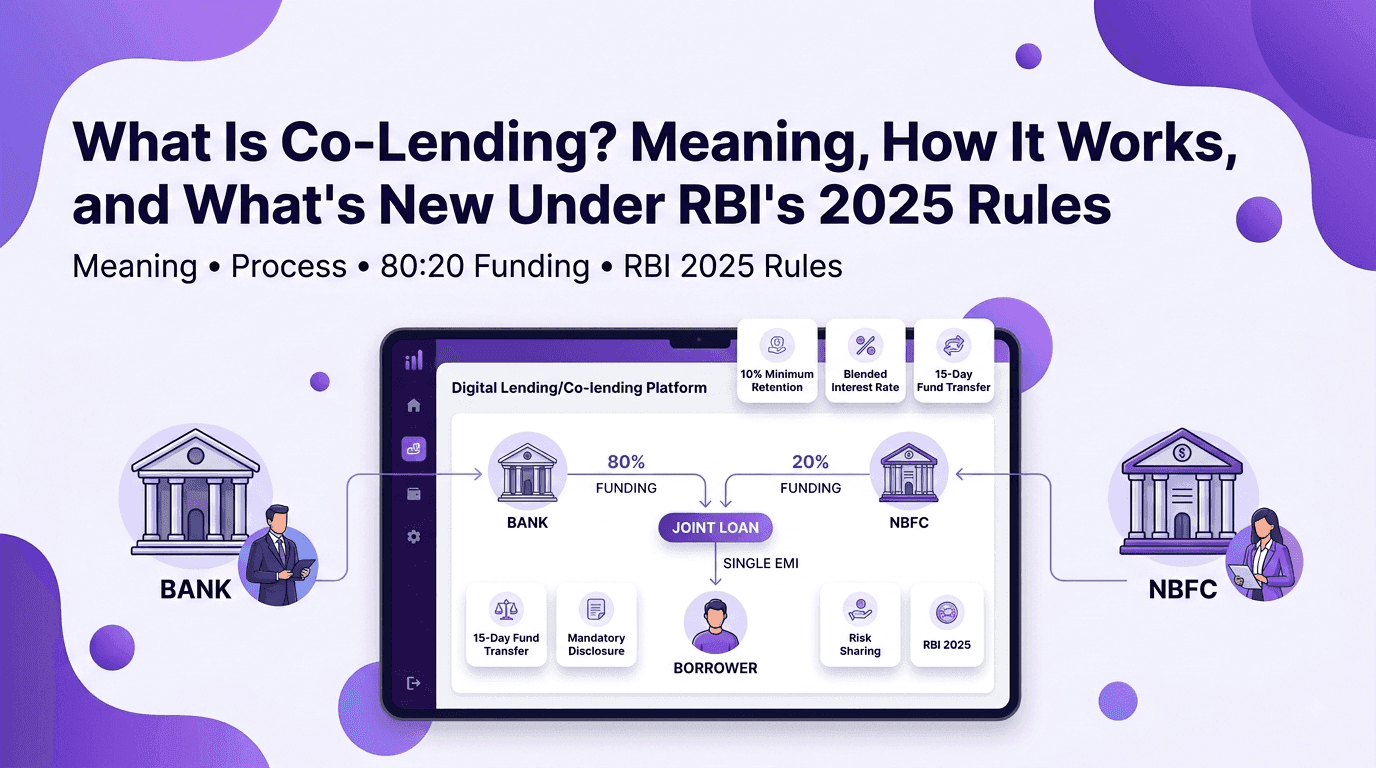
What Is Co-Lending? Meaning, How It Works, and What's New Under RBI's 2025 Rules
Co-lending is a lending model where a bank and an NBFC jointly fund the same loan, sharing the money and the risk in an agreed ratio, most commonly 80:20. The borrower gets one loan and one EMI schedule, even though two lenders are funding it behind the scenes. From 1 January 2026, this model is governed by the RBI (Co-Lending Arrangements) Directions, 2025, which widen who can co-lend, set a minimum retention of 10% for each lender, and introduce a blended interest rate for borrowers.
Introduction
If you've taken a personal loan, a business loan, or an MSME loan recently, there's a fair chance more than one lender was behind it, even if you only ever dealt with one.
That's co-lending. It's the reason a small NBFC with deep reach into a town a bank has never opened a branch in can still offer a loan priced almost as low as a bank's. And it's the reason banks have been able to grow their retail and priority sector books without hiring an army of local relationship managers.
The idea has been around since 2018, but it kept expanding. First it was banks and NBFCs on priority sector loans. Then, in 2020, RBI widened the pool of eligible NBFCs. Now, with the Co-Lending Arrangements Directions, 2025, the model is bigger and more strictly regulated than it has ever been.
This guide walks through what co-lending actually means, how the process works step by step, and exactly what changes under the new 2025 rules.
What Is Co-Lending?
Co-lending Co-lending is an arrangement where a bank and a Non-Banking Financial Company (NBFC) come together to jointly fund a loan for the same borrower.
The bank brings low-cost capital. The NBFC brings reach into markets banks find harder to serve, such as small towns, first-time borrowers, or self-employed applicants without a long credit history. Put the two together, and you get a loan that is cheaper for the borrower than a pure NBFC loan, and reaches further than a pure bank loan.
Here's a simple example. Say a borrower takes a personal loan of ₹1,00,000 under a co-lending arrangement with an 80:20 split:
- The bank funds ₹80,000
- The NBFC funds ₹20,000
The borrower still gets one loan, one EMI schedule, and one point of contact. They don't need to deal with two lenders separately. Behind the scenes, the two institutions are sharing the funding and the risk in the agreed ratio.
How Does Co-Lending Work? (Step by Step)
1. The borrower applies
The application usually starts with the NBFC, since it typically has the stronger local presence, digital reach, or existing customer relationship.
2. Joint eligibility check
Both the bank and the NBFC assess the borrower using their own credit policies: income, credit score, repayment history, and other risk parameters.
3. Funding and risk split
Once approved, the loan amount is split between the two lenders in a pre-agreed ratio, most commonly 80:20 in favour of the bank.
4. Single disbursement to the borrower
Even though two lenders fund the loan, the borrower receives it as one disbursement, typically through a shared escrow account that keeps both lenders' contributions separate and traceable.
5. Servicing and EMI collection
One lender, usually the NBFC, handles day-to-day servicing through its loan management system loan management system: EMI collection, reminders, and customer queries.
6. Repayment split
Every EMI collected is split back between the bank and the NBFC in the same ratio as the original funding.
7. Shared recovery, if needed
If the borrower defaults, both lenders absorb the loss in proportion to their share.
Co-Lending Ratio and Risk Sharing
The 80:20 ratio has been the industry norm since RBI first introduced co-lending guidelines in 2018 and expanded them in 2020. Under that model, the bank typically funded 80% of the loan and carried 80% of the risk, while the NBFC funded and absorbed the remaining 20%.
This ratio isn't fixed by law for every case. It's agreed between the two lenders based on their internal policies, though 80:20 remains the most widely used structure in the market.
What's New: RBI (Co-Lending Arrangements) Directions, 2025
On 6 July 2025, the RBI notified the Co-Lending Arrangements Directions, 2025, replacing the 2020 co-lending circular. These rules take effect from 1 January 2026, though lenders can adopt them earlier if their internal policies allow it.
Here's what changes:
1. Wider scope
Co-lending is no longer limited to banks partnering with NBFCs for priority sector loans. The new rules cover all commercial banks (excluding Small Finance Banks, Local Area Banks, and Regional Rural Banks), all NBFCs including HFCs, and All India Financial Institutions (AIFIs). It also now applies to lending outside the priority sector, not just within it.
2. Minimum retention on both sides
Each lender in a co-lending arrangement must now retain at least 10% of every individual loan on its own books. This applies to both the originating lender and the partner lender, so neither side can fully offload its exposure.
3. Blended interest rate
The rate charged to the borrower is now calculated as a weighted average of the interest rates each lender charges, based on their share of funding. Any change in one lender's rate must be reflected in this blended rate and communicated to the borrower.
4. Faster fund transfer
Funds must move between the lenders within 15 calendar days, tightening the timelines that used to cause delays and reconciliation gaps.
5. Mandatory disclosure
The Key Facts Statement given to the borrower must clearly mention the funding share of each lender, the applicable interest and charges, who services the loan, and how to escalate a complaint.
6. No more selective loan purchase
The earlier practice of NBFCs originating a large pool of loans and letting banks cherry-pick which ones to co-lend is no longer allowed under co-lending rules. Any such arrangement must now follow RBI's separate Transfer of Loan Exposures Directions instead.
For borrowers, this means clearer disclosures and a rate that reflects both lenders' pricing. For banks and NBFCs, it means updated credit policies, tighter fund-transfer systems, and closer coordination on reconciliation.
Types of Co-Lending Arrangements
1. Single primary lender:
One NBFC or bank partners with one co-lender. The simplest and most common structure.
2. Multiple co-lenders:
One primary lender partners with more than one co-lender to spread risk and fund larger loans.
3. Joint venture:
Both institutions set up a jointly owned entity to originate and manage the loans together.
4. Syndicated co-lending:
Several lenders form a group to fund a loan, sharing risk more widely, though coordination gets harder as the group grows.
Benefits of Co-Lending
For borrowers
- Interest rates closer to a bank's pricing than a standalone NBFC loan, since the blended rate pulls down what would otherwise be a higher NBFC-only rate
- Faster approval and disbursal than a pure bank loan, since the NBFC's digital processes and local presence speed up the front end
- Access to formal credit for borrowers with thin credit files, informal income proof, or no branch nearby, groups a bank would often decline on its own
- One EMI schedule and one point of contact, regardless of how many lenders are funding the loan behind the scenes
For banks
- A way to grow priority sector and retail lending without building the last-mile distribution NBFCs already have
- Shared credit risk instead of full exposure, since losses are split in the agreed ratio if a borrower defaults
- Entry into geographies and borrower segments, such as MSMEs and semi-urban retail, that would be expensive to reach through their own branch network
- Fee and interest income on loans they would not have been able to originate profitably alone
For NBFCs
- Access to bank capital at a cost far lower than their own market borrowing, which widens their margins
- The ability to price loans competitively without stretching their own balance sheet
- Faster growth in loan book size than their capital base would otherwise support
- A bank partnership that adds credibility with regulators and investors
For the broader lending ecosystem
- Wider financial inclusion, since co-lending is one of the few models that consistently reaches Tier II, Tier III, and rural borrowers at scale
- Better capital efficiency across the system, since capital-rich banks and reach-rich NBFCs are each doing the part they're best at
- A more resilient MSME and retail credit pipeline, since it doesn't depend on either a bank's branch network or an NBFC's balance sheet alone
Co-Lending vs Traditional Lending
| Parameter | Traditional Lending | Co-Lending |
|---|---|---|
| Number of lenders | One | Two or more |
| Interest rate | Set by a single lender | Blended rate across lenders |
| Loan accessibility | Mostly urban, established credit profiles | Wider reach, including underserved borrowers |
| Risk exposure | Carried by one lender | Shared in an agreed ratio |
| Processing speed | Often slower | Generally faster |
Challenges in Co-Lending Execution
Setting up a co-lending partnership on paper is the easy part. Running it day to day is where most of the difficulty sits:
- Coordinating loan decisions between two separate credit teams
- Tracking each lender's share of every disbursement and repayment accurately
- Meeting the new 15-day fund transfer timeline consistently
- Keeping records reconciled well enough to survive an RBI audit
- Updating credit policies and disclosure formats in line with the 2025 Directions
None of these are solvable through better coordination alone. They need a system built to handle the math and the paperwork automatically.
How Technology Platforms Like iFLOW Support Co-Lending Compliance
This is exactly the gap platforms like iFLOW are built to close. Instead of lenders tracking splits and reconciliation manually, iFLOW automates the parts of co-lending that the 2025 Directions now make mandatory: calculating the blended interest rate as each lender's terms change, tracking the 10% minimum retention on both sides, routing funds within the 15-day window, and maintaining the audit trail regulators will expect to see.
For a bank or NBFC entering a co-lending partnership, the compliance burden of the new rules is real. The right infrastructure turns that burden into a background process instead of a manual one. Book a demo to see how this works for your lending stack.
Conclusion
Co-lending works because it puts a bank's capital and an NBFC's reach behind the same loan. That combination is why it has grown from a niche priority-sector tool into one of the more important lending models in India.
The RBI's 2025 Directions push that model further. Wider participation, mandatory retention on both sides, a blended rate borrowers can actually understand, and tighter timelines all point toward a co-lending market that is more disciplined and more transparent than it was under the 2020 rules.
For lenders, the opportunity is the same as it always was: reach more borrowers while sharing the risk. What's different now is how much of that has to be proven with real data, on time, every time. That is the part infrastructure like iFLOW is built to handle, so lending teams can focus on growing the book instead of chasing reconciliation.
FAQs
Q - What is co-lending in simple terms?
Co-lending is when a bank and an NBFC jointly fund one loan for a borrower, sharing the money and the risk in an agreed ratio, most commonly 80:20.
Q - What is the co-lending ratio?
It's the proportion in which two lenders split the funding and risk of a loan. 80:20 is the most common structure, with the bank typically holding the larger share.
Q - Is co-lending safe for borrowers?
Yes. Borrowers deal with a single point of contact and one EMI schedule. Under the RBI's 2025 Directions, they also get clearer disclosure of each lender's share, the applicable interest rate, and how to raise a complaint.
Q - What changes under the RBI Co-Lending Arrangements Directions, 2025?
The rules widen who can co-lend, require each lender to keep at least 10% of every loan on its own books, introduce a blended interest rate, cut fund transfer timelines to 15 days, and end the practice of banks selectively picking loans from an NBFC's pool.
Q - Can two NBFCs co-lend with each other?
Yes, under the 2025 Directions, co-lending is permitted among all eligible commercial banks, NBFCs (including HFCs), and AIFIs, not just between a bank and an NBFC.
Q - How is the co-lending interest rate calculated?
It's a blended rate, worked out as a weighted average of each lender's interest rate based on their share of the funding. If one lender changes its rate, the blended rate is revised and communicated to the borrower.
Q - Can co-lending be used for MSME and business loans, or only personal loans?
Co-lending applies across loan categories, including personal loans, MSME loans, business loans, and secured loans such as loans against property, as long as both lenders agree to fund that category under their arrangement.
Q - Does a co-lending arrangement affect the borrower's credit score reporting?
No. The loan is reported to credit bureaus as a single loan account. The borrower's repayment history is tracked the same way it would be for any other loan, regardless of how many lenders are funding it internally.
Q - Does a co-lending arrangement affect the borrower's credit score reporting?
No. The loan is reported to credit bureaus as a single loan account. The borrower's repayment history is tracked the same way it would be for any other loan, regardless of how many lenders are funding it internally.
Q - Is there a minimum amount each lender must hold in a co-lending loan?
Yes. Under the 2025 Directions, each lender in the arrangement must retain at least 10% of every individual loan on its own books, rather than passing on its full exposure to the partner.
Q - Can two NBFCs co-lend with each other?
Yes, under the 2025 Directions, co-lending is permitted among all eligible commercial banks, NBFCs (including HFCs), and AIFIs, not just between a bank and an NBFC.