
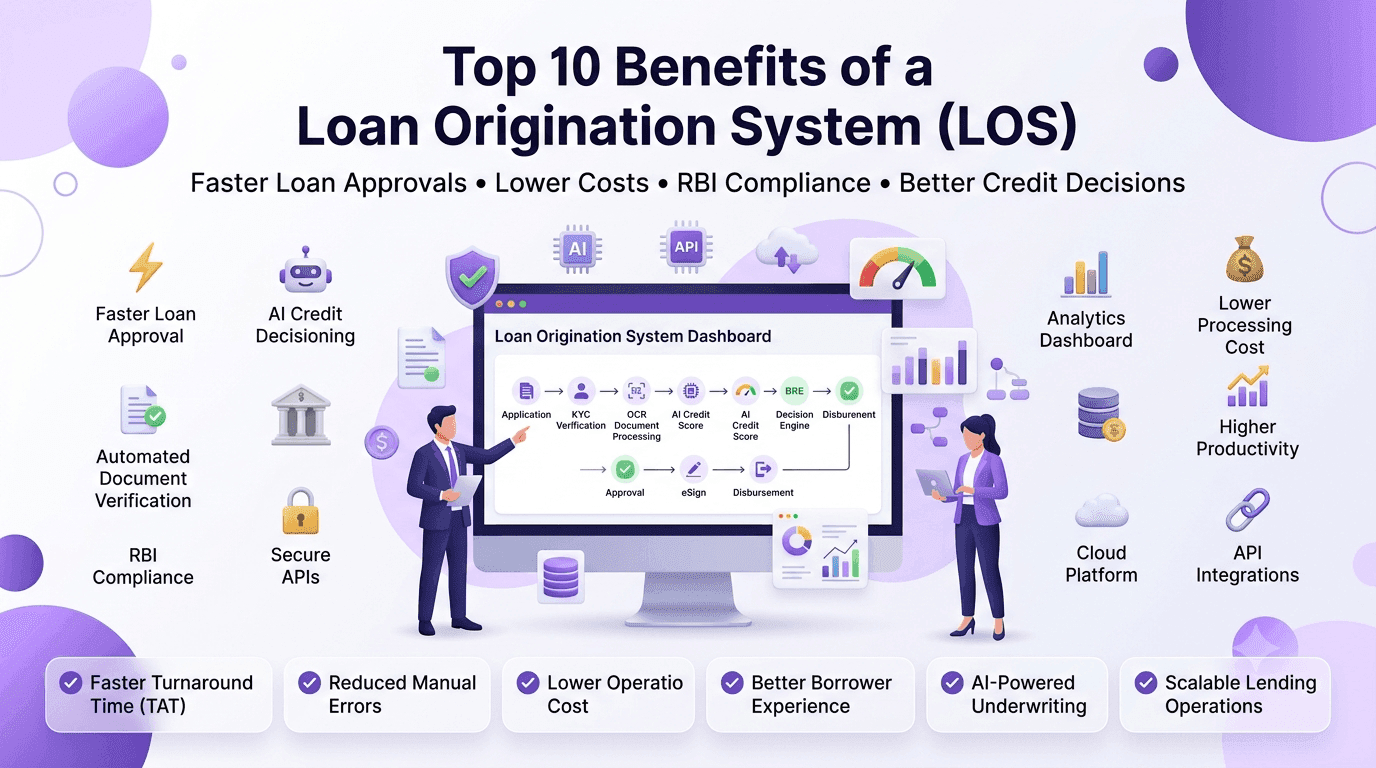
Top 10 Benefits of a Loan Origination System (LOS) for Banks & NBFCs
A Loan Origination System (LOS) helps banks and NBFCs process loans faster, cut manual errors, follow RBI rules with less effort, and give borrowers a better experience. The biggest benefits are faster turnaround time, lower processing cost, stronger compliance, and better credit decisions using data and AI.
Introduction
Loan applications keep piling up. Your credit team is checking documents by hand. Approvals that should take a day are taking a week. If this sounds familiar, you are not alone. Most banks and NBFCs in India face this problem as loan volumes grow faster than their old, manual processes can handle.
A Loan Origination System (LOS), fixes this. It is software that manages a loan from the first application to final disbursal. It checks documents, runs credit checks, applies your lending rules, and keeps every step on record. For lenders operating under RBI's Digital Lending Directions, this is not just a convenience anymore. It is close to a requirement.
Here are the top 10 benefits of using an LOS, explained in plain terms.
Top 10 Benefits of LOS
1. Faster Loan Turnaround Time (TAT)
Manual loan processing means paper forms, physical files, and people waiting on other people. An LOS removes most of this waiting. Once a borrower submits an application, the system pulls their data, runs checks automatically, and moves the file to the next step without anyone chasing it.
For lenders, this can cut approval time from several days to a few hours, especially for retail and MSME loans where volumes are high and loan sizes are smaller.
2. Fewer Manual Errors in Credit Decisions
People make mistakes when they enter data by hand or read through pages of documents. A missed number on an income statement or a wrong entry in a form can lead to a bad lending decision.
An LOS pulls data directly from the source, whether that is a bank statement, a credit bureau, or a KYC database. This cuts down on typing errors and reduces the number of loans that get approved or rejected for the wrong reason.
3. Better Compliance and Audit Readiness
Indian lenders work under strict rules from the RBI, including the Digital Lending Directions. An LOS builds these rules directly into the workflow. Every step, every check, and every approval gets logged automatically.
This means when an auditor or regulator asks for records, the lender does not need to dig through files. The system already has a complete, time-stamped trail of what happened and when.
Modern Loan Origination Systems also strengthen operational security with role-based user access, encrypted data storage, secure API integrations and detailed audit logs. These capabilities help lenders protect sensitive customer information, maintain data privacy, and support compliance with RBI guidelines and internal governance policies.
4. Lower Operating Cost Per Loan
Manual loan processing needs more people, more paper, and more time. All of this adds cost. When an LOS automates document checks, credit scoring, and approval routing, lenders need fewer people to process the same number of loans.
Over time, this brings down the cost of processing each loan, which matters a lot for NBFCs and fintechs working with thin margins on small-ticket loans.
5. A Better Experience for Borrowers
Borrowers today expect the same speed and simplicity they get from any app on their phone. Long forms, repeated document requests, and no visibility into application status push borrowers to look elsewhere.
An LOS gives borrowers a clear, digital journey. They can apply online, upload documents once, and track their application status in real time. Faster answers and fewer back-and-forth requests build trust and improve approval-to-disbursal conversion.
6. Workflows That Fit Different Loan Products
A bank or NBFC rarely sells just one loan product. Personal loans, business loans, and working capital loans all need different checks and approval steps. An LOS lets lenders set up separate workflows for each product without writing new code every time.
This flexibility means a lender can launch a new loan product in weeks instead of months, and adjust rules quickly when regulations or market conditions change.
7. Easier Co-Lending and Partner Integration
Co-lending between banks and NBFCs has grown fast in India, but it only works well when both partners can share data and decisions without delay. An LOS built for co-lending connects multiple lenders on one platform, so loan sourcing, credit checks, and fund disbursal happen in sync. If you want to understand the mechanics in more depth, here's how co-lending platforms work, including escrow and fund splitting.
This removes the back-and-forth emails and manual reconciliation that usually slow down co-lending deals.
8. Smarter Credit Decisions with AI and ML
Traditional credit checks rely on a small set of fixed rules. Modern LOS platforms use AI/ML score models to look at a wider range of data, including alternate data sources, to judge a borrower's repayment ability. This works alongside a Business Rule Engine (BRE) that applies your lending policy consistently across every application.
This helps lenders say yes to more good borrowers who might get rejected under old scoring methods, while also catching risky applications that manual checks might miss.
9. Built to Handle Growth
A lender processing 500 loans a month has very different needs from one processing 50,000. Manual systems and spreadsheets break down as volume grows. An LOS is built to scale, so a sudden jump in applications during a festive season or a new product launch does not overwhelm the credit team.
This matters most for lenders with big growth plans, since scaling on paper-based systems usually means scaling headcount, not just technology.
10. Real Data for Better Business Decisions
Every step in an LOS generates data: how long each stage takes, where applications get stuck, which borrower segments have higher approval rates, and more. This data, when tracked properly, gives lenders a clear picture of what is working and what is not.
Instead of guessing why approval rates dropped last month, credit and risk teams can look at real numbers and fix the actual problem.
LOS vs Manual Loan Processing
| Factor | Manual Process | With LOS |
|---|---|---|
| Loan turnaround time | 3-7 days | Few hours to 1 day |
| Error rate | Higher, due to manual entry | Lower, data pulled automatically |
| Cost per loan | Higher (more staff, more paper) | Lower (automated workflows) |
| Compliance tracking | Manual record-keeping | Automatic audit trail |
| Scalability | Needs more staff to grow | Scales without major headcount increase |
Who Benefits Most from an LOS?
Banks: Modernize lending without replacing their entire core banking system, and roll out new products faster.
NBFCs: Process high volumes of small-ticket loans at low cost while staying compliant with RBI norms.
Fintechs: Launch new lending products quickly using configurable, no-code workflows instead of building from scratch.
Co-lending partners: Run joint lending programs with shared visibility into sourcing, underwriting, and disbursal.
How to Pick the Right LOS for Your Business
Not every LOS platform is built the same way. Before picking one, check for:
-
Configurability: Can you set up different workflows for different loan products without needing developers every time?
-
Compliance readiness: Does it support RBI Digital Lending Directions and other regulatory requirements out of the box?
-
Integration support: Can it connect with credit bureaus, KYC databases, and your core banking or Loan Management System (LMS) through APIs? (If you're evaluating your LMS at the same time, this guide on how to choose the right Loan Management System covers what to look for.)
-
AI-based credit decisioning: Does it support alternate data and machine learning models for underwriting?
-
Scalability: Can it handle a sudden jump in loan volume without breaking down?
Conclusion
A Loan Origination System is not just about going digital. It is about approving good loans faster, cutting the cost of every loan you process, and staying compliant without extra manual work. For banks and NBFCs looking to grow in India's fast-moving lending market, LOS has become less of an option and more of a basic requirement.
Want to see how a modern LOS can work for your lending business? Book a demo with iFLOW and see the platform in action.
FAQs
Q1. What are the main benefits of an LOS for NBFCs?
An LOS helps NBFCs process loans faster, reduce operational costs, improve compliance with RBI regulations, and manage higher loan volumes without significantly increasing staff.
Q2. How does an LOS reduce loan processing time?
It automates document verification, credit scoring, and approval workflows, allowing applications to move through each stage without manual follow-ups and reducing turnaround time from days to hours.
Q3. Is an LOS compliant with RBI digital lending guidelines?
A well-designed LOS supports compliance with RBI's Digital Lending Directions by enabling proper disclosures, secure data handling, and complete audit trails. Lenders should confirm specific compliance features with their vendor.
Q4. What is the difference between an LOS and an LMS?
An LOS manages the loan journey from application to disbursal, while an LMSLoan Mnagement System handles post-disbursal activities such as repayments, collections, servicing, and loan restructuring.
Q5. Can an LOS integrate with an existing core banking system?
Yes, modern LOS platforms integrate with core banking systems, credit bureaus, KYC providers, and other third-party services through APIs, allowing lenders to adopt the system without replacing existing infrastructure.
Q6. How long does it take to implement an LOS?
A configurable, no-code LOS can typically be implemented within a few weeks for a single loan product. More complex, multi-product deployments with legacy system integrations may require additional time.
Q7. Does an LOS support MSME and business loans, or only retail loans?
A configurable LOS supports both retail and MSME/business lending by enabling separate underwriting rules and workflows for different loan products without requiring separate systems.