
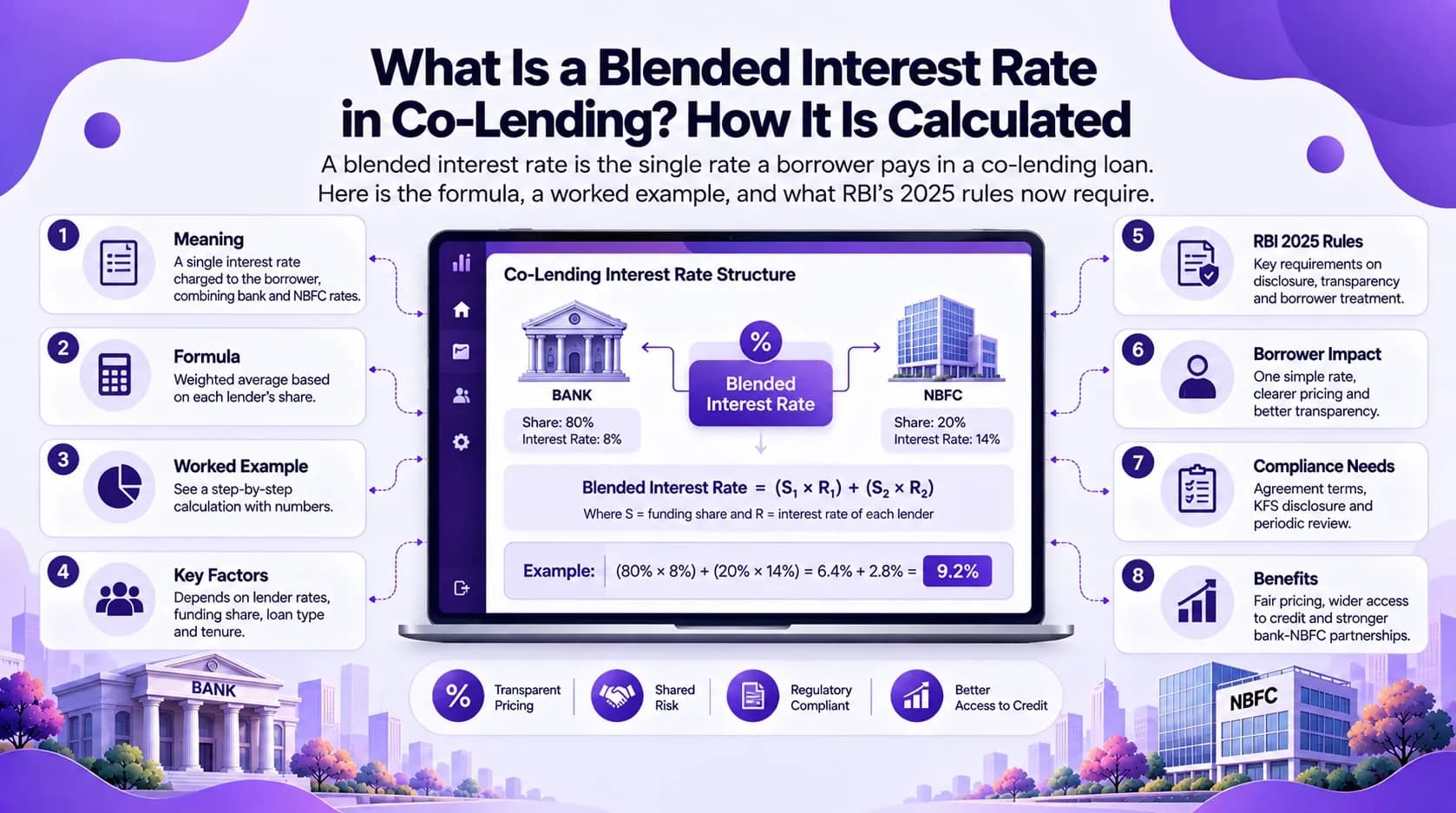
What Is a Blended Interest Rate in Co-Lending? How It Is Calculated
A blended interest rate in co-lending is the single interest rate a borrower is charged when a bank and an NBFC fund the same loan together. It is calculated as a weighted average of each lender’s own rate, based on how much of the loan each one funds. Under RBI’s Co-Lending Arrangements Directions, 2025, effective 1 January 2026, this blended rate is mandatory, must be disclosed to the borrower upfront, and must be recalculated if either lender changes its rate. samrat
Introduction
One of the biggest changes in RBI’s new co-lending rules is how the borrower is charged. Earlier, rate-setting in co-lending arrangements was fairly flexible and worked out between partners. From 1 January 2026, that flexibility is gone. Every co-lending loan must carry one blended interest rate, calculated in a specific way, and shown clearly to the borrower. This sounds simple, but it trips up a lot of teams in practice, especially when rates change mid-term or the funding split is not the standard one. Here is how the blended rate actually works.
Why a Blended Rate Exists
In co-lending, two lenders fund one loan, and they usually have different costs of funds. A bank typically lends at a lower rate than an NBFC. If both charged separately, the borrower would face two rates on a single loan, which is confusing and hard to compare against other loan offers. The blended rate solves this. The borrower sees one rate, one EMI, and one repayment schedule, even though two lenders are funding it behind the scenes. It also makes co-lending loans comparable to regular loans when a borrower is shopping around.
How the Blended Interest Rate Is Calculated
The blended rate is a weighted average. Each lender’s rate is weighted by the share of the loan that lender funds, and the two are added together. The formula is: Blended Rate = (Bank’s share % × Bank’s rate) + (NBFC’s share % × NBFC’s rate) A Simple Example Say a borrower takes a ₹10,00,000 loan under a co-lending arrangement:
- The bank funds 70% (₹7,00,000) at 10% interest
- The NBFC funds 30% (₹3,00,000) at 16% interest The calculation works out as:
- Bank’s contribution: 0.70 × 10% = 7.0%
- NBFC’s contribution: 0.30 × 16% = 4.8%
- Blended rate = 7.0% + 4.8% = 11.8% So the borrower is charged 11.8%, not 10% and not 16%. Each lender still earns its own rate on its own share, but the borrower deals with a single, simple number.
What Happens If the Split Changes
If the split were 60:40 instead, using the same rates:
- Bank: 0.60 × 10% = 6.0%
- NBFC: 0.40 × 16% = 6.4%
- Blended rate = 12.4% The more the NBFC funds, the higher the blended rate tends to be, since NBFCs usually price higher than banks. This is why the funding split is not just a capital decision. It directly affects what the borrower pays.
What RBI’s 2025 Rules Require
Under the Co-Lending Arrangements Directions, 2025, a few things about the blended rate are now non-negotiable:
- The borrower must be charged one blended rate, not separate rates from each lender
- The rate must be calculated as a weighted average based on each lender’s funding share
- If either lender changes its rate during the loan term, the blended rate must be recalculated and disclosed again
- All fees and charges must be reflected in the Annual Percentage Rate shown to the borrower
- The Key Facts Statement given to the borrower must show each lender’s share, the applicable rate, who services the loan, and how to raise a complaint
For a full breakdown of what else changed, see our guide to the RBI Co-Lending Arrangements Directions, 2025.
Why This Is Hard to Do Manually
On a single loan, this calculation is easy. Across thousands of loans, with different splits, different rates, and rates that change over time, it stops being easy fast.
The common problems we see:
-
Rate changes mid-term. If a bank revises its lending rate, every affected loan’s blended rate needs recalculating and re-disclosing. Doing that by hand across a live portfolio is not realistic.
-
Non-standard splits. Teams build processes around one default ratio, then struggle when a deal uses a different one.
-
Disclosure lag. The rate gets recalculated internally but the borrower-facing document does not update, which creates a compliance gap.
This is why the blended rate calculation is one of the first things worth testing when choosing a co-lending platform. A platform should handle this automatically, including recalculation and disclosure, without anyone doing the math in a spreadsheet.
Quick Reference
| Detail | |
|---|---|
| What it is | One interest rate charged to the borrower in a co-lending loan |
| How it is calculated | Weighted average of each lender’s rate, by funding share |
| Formula | (Bank share × Bank rate) + (NBFC share × NBFC rate) |
| When it must be updated | Whenever either lender changes its rate |
| Required from | 1 January 2026, under RBI’s 2025 Directions |
| Must be disclosed in | The Key Facts Statement, along with the APR |
Conclusion
The blended interest rate is what makes a co-lending loan feel like a normal loan to the borrower. One rate, one EMI, one schedule, even though two lenders are funding it. The maths behind it is straightforward, but keeping it accurate across a live portfolio, with changing rates and varying splits, is where it gets difficult. If your systems still calculate this manually or update the borrower disclosure separately, that is worth fixing before the 2025 Directions take full effect.
FAQs
Q - What is a blended interest rate in co-lending?
It is the single interest rate charged to a borrower when a bank and an NBFC jointly fund a loan, calculated as a weighted average of each lender’s rate based on their share of the loan.
Q - How do you calculate a blended interest rate?
Multiply each lender’s funding share by its own interest rate, then add the results together. For example, a 70% bank share at 10% plus a 30% NBFC share at 16% gives a blended rate of 11.8%.
Q - Is a blended interest rate mandatory in co-lending?
Yes. Under RBI’s Co-Lending Arrangements Directions, 2025, effective 1 January 2026, the borrower must be charged a single blended rate rather than separate rates from each lender.
Q - What happens if a lender changes its interest rate mid-loan?
The blended rate has to be recalculated to reflect the new rate, and the updated rate must be disclosed to the borrower.
Q - Does the borrower see both lenders’ individual rates?
The borrower is charged the blended rate, but the Key Facts Statement must disclose each lender’s funding share and the applicable rate and charges.
Want to see blended rate calculation and disclosure handled automatically? Book a demo with iFLOW.