
What Is a Syndicated Loan? Meaning, Process, and Types Explained
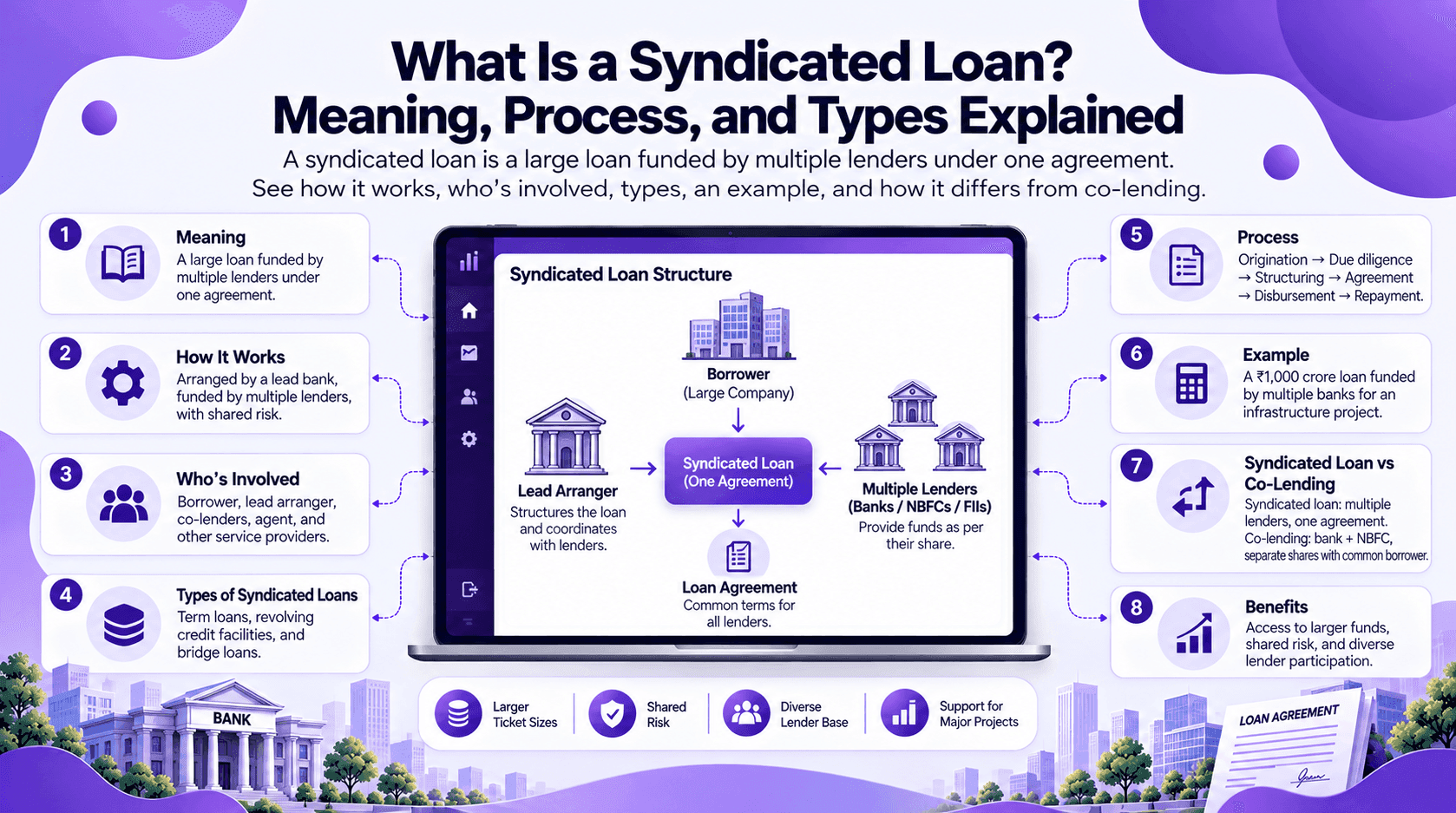
A syndicated loan is a single large loan funded by a group of lenders, not just one, working together under one shared agreement. One bank, called the lead arranger, structures the deal and brings the other lenders on board. Each lender funds a portion of the loan and carries risk only for its own share, while the borrower deals with the group as if it were one lender. Businesses use syndicated loans when the amount they need is too large, or too risky, for any single bank to fund on its own, think infrastructure projects, acquisitions, or large working capital needs running into hundreds of crores.
Introduction
If you have ever wondered how a company raises a loan of ₹500 crore or more, the answer is almost never “one bank wrote a cheque.” At that size, a single lender rarely wants that much exposure to one borrower, and in India, RBI’s own exposure norms often will not let them even if they wanted to. So banks do what makes sense: they share the loan.
That is loan syndication. It is one of the oldest tools in corporate banking, and it is still how most large-ticket financing gets done in India today, from power plants to airport expansions to big-ticket acquisition financing.
This piece walks through what a syndicated loan actually is, how the process works step by step, the different types of syndication you will come across, and where it differs from co-lending, a term people often confuse it with.
What Is a Syndicated Loan?
A syndicated loan is a loan provided to one borrower by a group of lenders, all operating under a single, common loan agreement. Instead of a borrower signing separate loan contracts with five different banks, there is one agreement, one set of terms, and one administrative process, even though multiple lenders are funding it.
The lender group is called a syndicate. One institution, usually the one with the strongest relationship with the borrower or the deepest balance sheet, takes on the role of lead arranger. The lead arranger negotiates terms with the borrower, prepares the documentation, and then invites other banks to take a share of the loan.
This structure exists for one simple reason: risk gets too concentrated otherwise. A single large loan on one bank’s books is a single large bet on one borrower. Spread that same loan across eight or ten lenders, and no one bank is overexposed if the borrower runs into trouble.
In India, this isn’t just good practice, it’s partly shaped by regulation. Under RBI’s Large Exposures Framework, a bank’s exposure to a single borrower is capped, broadly, at 20% of its eligible capital base, with a higher ceiling for a group of connected borrowers. For a borrower needing a large loan, that cap alone often makes syndication the only realistic route.
Key Parties in a Syndicated Loan
A syndicated loan involves more moving parts than a standard bilateral loan. Here’s who’s actually in the room:
- The borrower: the company raising the funds, typically for a large project, acquisition, or working capital need
- The lead arranger (or lead bank): structures the deal, negotiates with the borrower, and recruits other lenders
- Syndicate members (participating lenders): banks or financial institutions that commit a portion of the loan and share the risk and returns
- The agent bank: usually the lead arranger, this institution administers the loan day to day: collecting repayments, distributing them to lenders, and handling ongoing communication
On a large, complex deal, you might also see a separate security trustee managing collateral on behalf of all lenders, but the four roles above are the ones present in nearly every syndicated loan.
How the Loan Syndication Process Works
The syndication process follows a fairly predictable sequence. Here’s how it typically plays out:
The borrower identifies a financing need
A company planning a large capital expenditure, an acquisition, or a major expansion approaches a bank for funding that’s simply too large for that bank to comfortably hold alone.
A lead arranger is appointed
The borrower, often working with its existing relationship bank, appoints a lead arranger. This bank takes on the heavy lifting: credit appraisal, structuring the deal, and preparing the information memorandum that other lenders will review.
Lenders are invited to participate
The lead arranger approaches other banks and financial institutions, sharing deal terms and inviting them to take a share. Each participating lender runs its own credit assessment before committing, even though the terms are standardised across the syndicate.
The loan agreement is finalised and disbursed
Once enough lenders have committed, a single loan agreement is signed by all parties. Funds are disbursed according to each lender’s agreed share.
The loan is administered on an ongoing basis
The agent bank tracks repayments, allocates interest and principal to each lender based on their share, and keeps the syndicate informed through regular reporting. This can run for years on a large infrastructure loan.
Types of Loan Syndication
Not every syndicated loan is structured the same way. There are three broad types, and which one gets used usually comes down to how much risk the lead arranger is willing to carry upfront.
Underwritten syndication
The lead bank commits to funding the entire loan amount itself, and only afterward works to sell down portions to other lenders. This gives the borrower funding certainty, since the deal happens regardless of how syndication goes, but it means the lead bank carries the full risk until the loan is successfully distributed.
Best-efforts syndication
Here, the lead bank only commits to trying to raise the full amount from other lenders, without guaranteeing it. If the syndicate can’t be fully formed, the loan amount may be reduced, or the deal restructured. This shifts more risk onto the borrower, since funding isn’t guaranteed in full.
Club deal
A smaller, often pre-existing group of lenders, typically five to ten, comes together for a deal, usually one that’s large but not large enough to need a full-scale syndication process. Because the lenders already know and trust each other, documentation and timelines tend to move faster.
In India, you’ll also come across the term consortium lending, which is closely related but not identical. In a consortium, a fixed group of banks jointly finances a borrower’s working capital needs, often over a long-standing relationship, with each bank’s share based on a common assessment. Syndication, by contrast, is typically formed deal-by-deal for a specific financing need, and is more commonly used for term loans and project finance.
A Loan Syndication Example
Here’s a simplified example to make this concrete.
Say an infrastructure company needs ₹1,000 crore to build a new highway stretch. No single bank wants that much exposure to one borrower, partly because of RBI’s exposure norms, and partly because no risk team wants that much concentration in one project.
A lead bank agrees to arrange the deal. It brings in four other lenders, and the ₹1,000 crore is split roughly as follows: the lead bank takes ₹300 crore, and four other banks take ₹175 crore each. All five lenders sign one common loan agreement, with identical interest rates and repayment terms. The borrower makes one EMI-style payment each cycle to the agent bank, which then distributes the repayment to each lender according to their share.
To the borrower, it feels like dealing with one lender. Behind the scenes, five institutions are managing their own slice of the exposure.
Advantages and Disadvantages of Loan Syndication
Syndication is a trade-off, and the trade-off looks different depending on which side of the deal you are on.
For Borrowers
| Advantages | Disadvantages |
|---|---|
| Access to much larger capital than any single lender could offer | Takes longer to close than a bilateral loan, since every lender runs its own due diligence |
| Often more competitive pricing, as lenders compete for attractive deals | Heavier documentation, with legal and administrative costs passed on to the borrower |
| One set of terms and one point of contact, despite multiple lenders | Amendments or waivers need syndicate-wide agreement, which can slow decisions down |
| Builds relationships with several banks through a single transaction | Less flexibility to renegotiate terms with just one lender later |
For Lenders
| Advantages | Disadvantages |
|---|---|
| Risk diversification, with no single borrower dominating the balance sheet | Heavy reliance on the lead arranger’s credit assessment |
| Access to large, fee-generating deals they could not fund alone | Limited control over deal terms, since the arranger negotiates them |
| Steady servicing and arrangement fee income over the loan’s life | Amendments and waivers need group agreement, which can be slow |
| Less origination effort, since the arranger leads structuring and documentation | Tracking allocations and repayments across lenders needs strong operational systems |
That last point matters in practice. Once a lender runs more than a handful of syndicated deals, spreadsheets stop working, which is why banks and NBFCs increasingly manage multi-lender allocations through a proper loan management system
What Are the Benefits of Using Syndicated Loans?
Syndication pays off for both sides of the deal. Here are the benefits that matter most, one by one.
Access to Much Larger Funding
A syndicate can fund amounts well beyond what any single bank is willing to underwrite alone. That is why large infrastructure, acquisition, and expansion financing in India almost always goes this route.
Faster Execution Through One Agreement
It sounds counterintuitive with so many parties involved, but one common loan agreement negotiated through a lead arranger is still faster than running separate negotiations with five banks, each asking for its own covenants and documents.
Less Dependence on a Single Lender
A borrower relying on one bank is exposed if that bank’s lending capacity tightens, whether from capital pressure, regulatory limits, or a change in risk appetite. A syndicate spreads that exposure, so the loan does not depend on one balance sheet.
More Competitive Pricing
When several lenders compete for a share of an attractive deal, borrowers usually get better terms than they would negotiating with one bank alone.
Exposure Limits Stay Intact for Lenders
RBI’s Large Exposures Framework caps how much a bank can lend to a single borrower. Syndication lets a bank take part in a large deal without breaching its own limits.
Fee Income From Deals Lenders Could Not Fund Alone
A mid-sized lender that cannot fund a ₹1,000 crore loan can still take a ₹100-150 crore share, and earn servicing and arrangement fees on it for the life of the loan.
Who Can Benefit From Syndicated Loans?
In practice, syndication fits a narrow but important band of borrowers: those whose financing need is too large, or too risky to concentrate in one place, for a bilateral loan to work. That usually means large corporates funding expansion or acquisitions, infrastructure developers financing projects that run for years, and government-linked entities raising capital for public infrastructure.
It is generally not the right tool for smaller financing needs. If a single relationship bank is comfortable holding the full exposure, syndication adds process and cost without adding real benefit.
Loan Syndication vs Co-Lending
People often use the two terms interchangeably, but RBI treats them as different structures. RBI’s own FAQs on the 2025 Co-Lending Directions explicitly carve out syndication and consortium lending from the co-lending framework.
| Loan Syndication | Co-Lending | |
|---|---|---|
| Who’s involved | Multiple banks, led by one arranger | Typically a bank and an NBFC |
| Underwriting | Lenders rely largely on the lead arranger’s assessment | Each lender underwrites independently |
| When the second lender joins | Before disbursal, as part of a formed syndicate | Before disbursal, jointly from origination |
| Common use case | Large corporate loans, project finance, acquisitions | Retail and MSME lending |
| Borrower-facing rate | Can vary by each lender’s own pricing within the syndicate | One mandatory blended rate under RBI’s 2025 Directions |
| Governed by | Multiple banking and consortium norms | RBI Co-Lending Arrangements Directions, 2025 |
These are not competing options for the same deal. A ₹1,000 crore infrastructure loan is syndication territory, while a retail loan jointly funded by a bank and an NBFC is co-lending territory. For the full picture, including loan assignment as a third structure, see co-lending vs loan syndication vs loan assignment.
Conclusion
A syndicated loan is simply how large borrowing gets shared safely across multiple lenders, structured under one agreement, led by one arranger, and funded by a group that each carries only its own piece of the risk. It remains the standard route for financing big-ticket needs in India, project finance, acquisitions, and large working capital facilities, partly because it works, and partly because RBI’s exposure norms leave few other options at that scale.
Understanding the mechanics, the roles, the process, and the types, matters whether you’re a borrower evaluating financing options or a lender building the systems to manage a syndicated book.
If your lending business handles syndicated, participation, or multi-lender structures, iFLOW helps manage the full loan lifecycle, from Loan origination System through servicing, so multi-lender allocations don’t have to be tracked in a spreadsheet.
FAQs
Q - What is a syndicated loan?
A syndicated loan is a large loan provided to one borrower by a group of lenders working under a single, common loan agreement, rather than separate agreements with each lender.
Q - Who are the parties involved in a syndicated loan?
The main parties are the borrower, the lead arranger who structures and coordinates the deal, the syndicate members who each fund a portion of the loan, and the agent bank, which administers repayments and communication.
Q - What is the difference between loan syndication and loan participation?
In loan syndication, multiple lenders jointly originate the loan under one shared agreement with the borrower. In loan participation, one lender originates the loan on its own and then sells portions of it to other lenders under separate agreements.
Q - What is a broadly syndicated loan?
A broadly syndicated loan is a large corporate loan arranged by a lead bank and then distributed to a wide base of institutional lenders, often traded further in the secondary market.
Q - What are the disadvantages of loan syndication?
The main disadvantages are longer timelines due to multiple lenders completing due diligence, heavier documentation and legal costs, and slower decision-making when the syndicate needs to agree on amendments or waivers.
Q - Is loan syndication the same as co-lending?
No. Loan syndication typically involves multiple banks sharing a large corporate loan under one lead arranger. Co-lending, under RBI’s 2025 Directions, is usually a bank and an NBFC jointly underwriting and funding a loan from origination, most common in retail and MSME lending. RBI treats syndication and consortium lending as separate from the co-lending framework.