
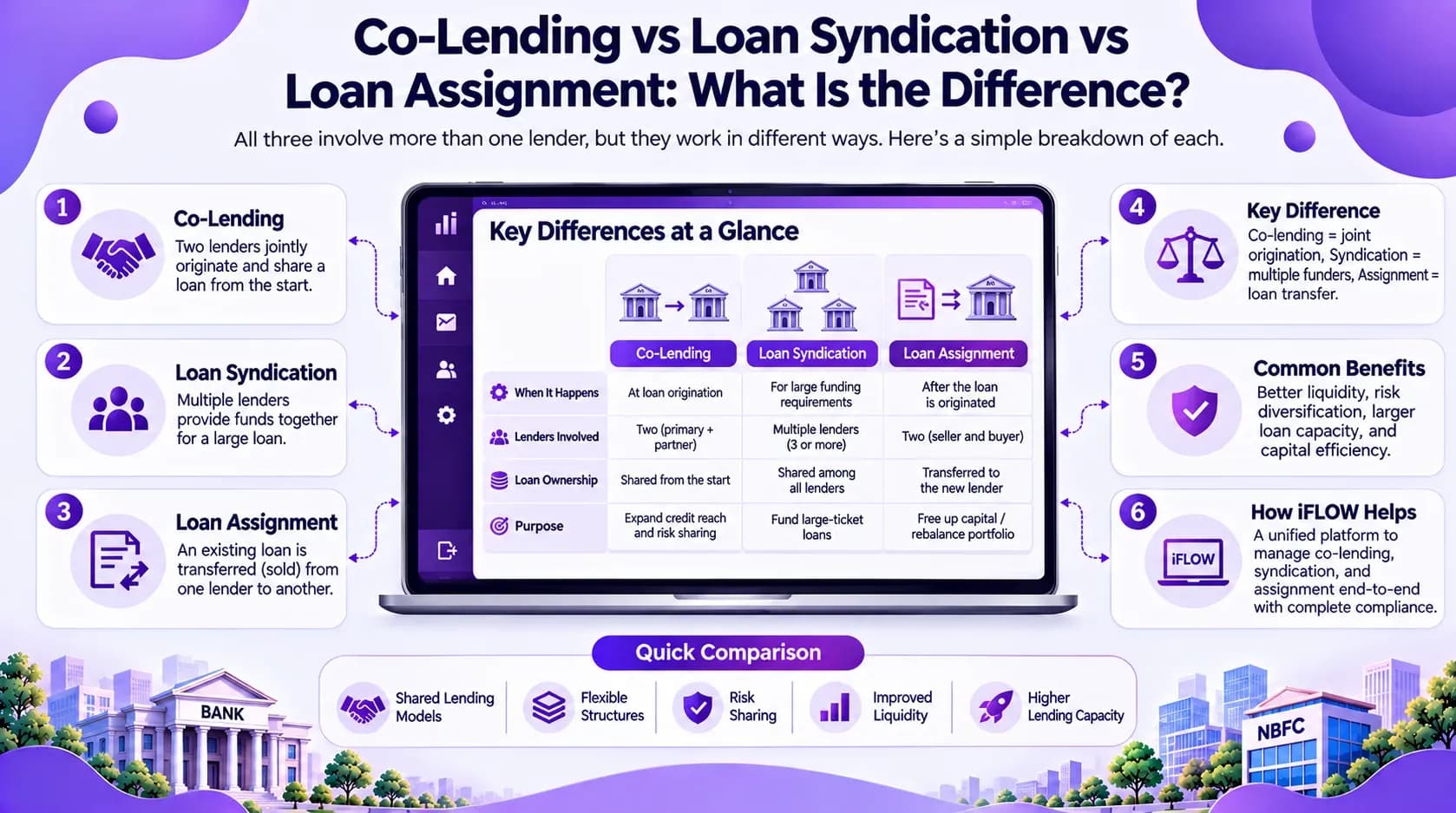
Co-Lending vs Loan Syndication vs Loan Assignment: What Is the Difference?
Co-lending, loan syndication, and loan assignment all involve more than one lender, but they are not the same thing. Co-lending means a bank and an NBFC jointly fund and own a loan under RBI’s co-lending rules. Loan syndication means multiple banks fund one large loan together, usually for a big corporate borrower. Loan assignment (or direct assignment) means an NBFC sells a pool of loans it has already given out to a bank, and the bank takes over ownership of them. The lenders involved, who owns the loan, and which RBI rules apply are all different in each case.
Introduction
If you work in lending, you have probably heard these three terms used almost interchangeably, co-lending, syndication, and assignment. They do sound similar. All three involve more than one financial institution getting involved in funding a loan. But mix them up in a compliance conversation or a partnership agreement, and it can cause real confusion, especially now that RBI’s Co-Lending Arrangements Directions, 2025 draw a clear line around what actually counts as co-lending.
This guide breaks down what each term actually means, how they are structured differently, and why the difference matters if you are a bank, an NBFC, or building the technology behind any of these models.
What Is Co-Lending?
Co-lending is when a bank and an NBFC jointly fund a single loan to a borrower, from the start. Both lenders are involved before the loan is disbursed, both hold a share of it on their own books, and the borrower deals with it as one loan, usually through the NBFC as the customer-facing partner.
Under the new RBI Co-Lending Arrangements Directions, 2025, effective from 1 January 2026, each lender must retain at least 10% of every loan, and the borrower is charged one blended interest rate that reflects both lenders’ pricing. This is what makes co-lending fundamentally a joint-origination model, not a resale of loans after the fact.
What Is Loan Syndication?
Loan syndication is a completely different structure. Here, a group of banks come together to fund one large loan, usually for a big corporate borrower who needs more money than any single bank wants to lend on its own. One bank typically acts as the lead or managing bank, negotiates the terms with the borrower, and coordinates the other banks in the syndicate.
Syndication is common in large corporate and project finance, not retail or MSME lending, and it does not involve an NBFC sourcing the customer the way co-lending does. RBI’s 2025 Co-Lending Directions specifically do not apply to loans structured as multiple banking, consortium lending, or syndication arrangements, so this stays governed separately.
What Is Loan Assignment (Direct Assignment)?
Loan assignment, often called direct assignment, works differently again. Here, an NBFC has already originated and disbursed a pool of loans using its own money. Later, it sells this pool to a bank, transferring ownership of those loans to the bank in exchange for a lump sum, usually recovering a large share of its capital.
The key difference from co-lending is timing and ownership. In co-lending, the bank is involved from day one and jointly owns each loan as it is created. In direct assignment, the bank buys into loans that already exist, after the NBFC has already carried the risk of originating them. This falls under RBI’s separate loan transfer and securitisation framework, not the Co-Lending Directions.
Why This Difference Actually Matters
If you are building or buying technology for any of these models, the difference is not just academic. A platform built for co-lending needs to handle joint origination, blended rate calculation, and real-time data sharing between a bank and an NBFC, exactly what we cover in how to choose a co-lending platform. A platform built for loan assignment needs to handle bulk pool transfer and due diligence instead. Using the wrong framework, or assuming one platform can casually handle all three, is how compliance gaps happen later.
Conclusion
Co-lending, loan syndication, and loan assignment all bring more than one lender into the picture, but they solve different problems and follow different rules. Co-lending is joint origination between a bank and an NBFC. Syndication is multiple banks sharing one large corporate loan. Assignment is a sale of an existing loan pool. Knowing which one you are actually dealing with matters for compliance, for technology, and for how the borrower experiences the loan.
Building or evaluating a platform for co-lending specifically? Book a demo with iFLOW to see how the compliance and reconciliation layer works.
FAQs
Q - Is co-lending the same as loan syndication?
No. Co-lending is a bank and an NBFC jointly funding a single retail or MSME loan from the start. Loan syndication is multiple banks jointly funding one large corporate loan, usually led by a managing bank.
Q - What is the difference between co-lending and direct assignment?
In co-lending, the bank is involved before the loan is disbursed and jointly owns it from day one. In direct assignment, the NBFC has already disbursed the loan on its own, and later sells the existing loan pool to a bank.
Q - Does RBI’s 2025 Co-Lending framework apply to syndicated loans?
No. The RBI Co-Lending Arrangements Directions, 2025 specifically exclude loans structured as multiple banking, consortium lending, or syndication.
Q - Which model is better for an NBFC, co-lending or direct assignment?
It depends on the goal. Co-lending helps an NBFC access a bank’s capital and share risk from the start of every loan. Direct assignment helps an NBFC free up capital quickly by selling off loans it has already funded.