
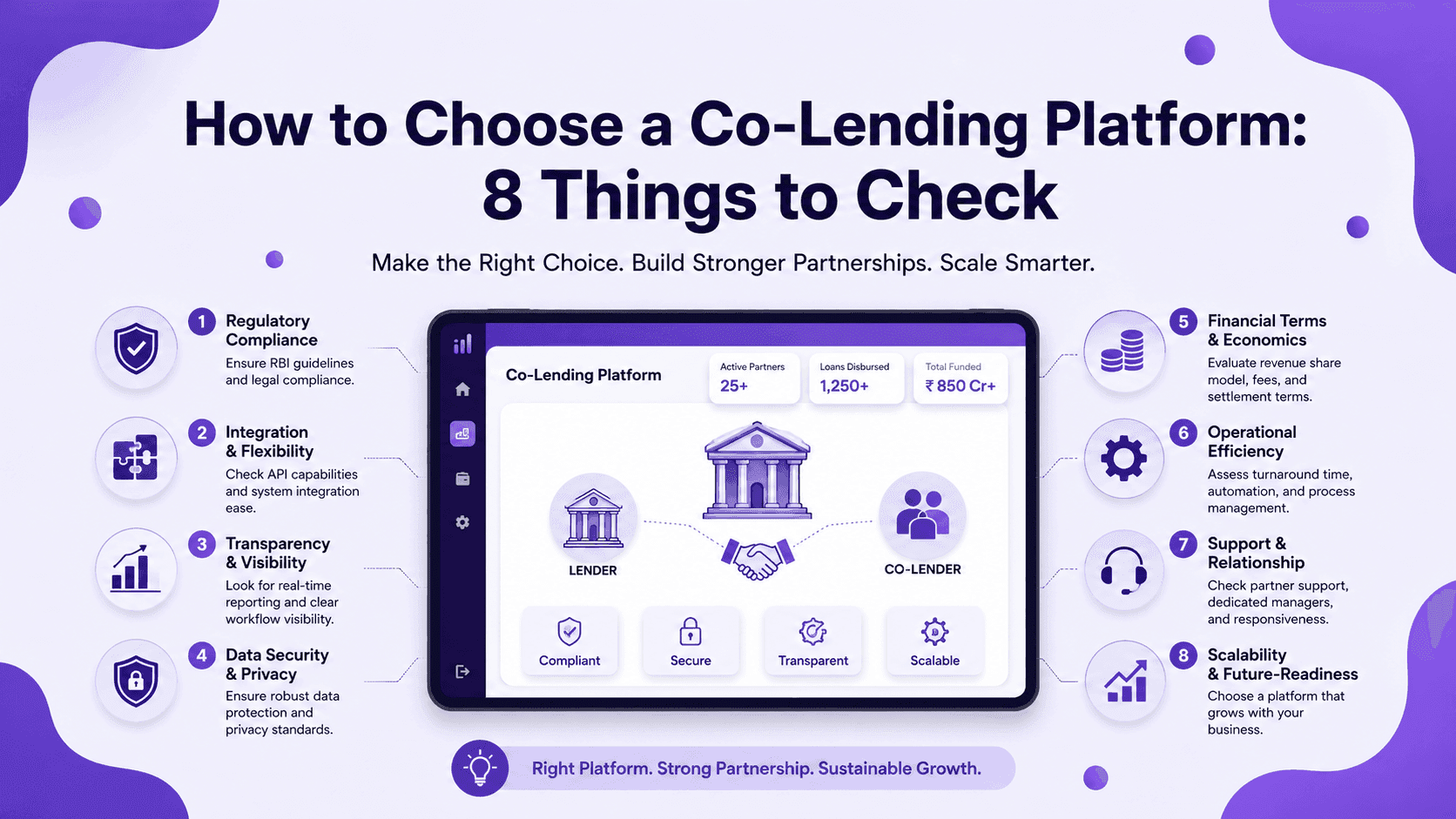
How to Choose a Co-Lending Platform: 8 Things to Check
To choose the right co-lending platform, check these 8 essential criteria: RBI regulatory readiness, real-time API integration, loan underwriting strength, enterprise data security, transparent fund flows, disbursal speed, daily MIS reporting, and vendor track record. A good co-lending platform connects banks and NBFCs in real time to automate loan splits, calculate single blended interest rates, track minimum 10% risk retention, and share identical daily reconciliation data. Missing any of these features leads to regulatory non-compliance, delayed disbursals, and operational breakdown.
Introduction
Picking the wrong co-lending platform causes real problems later. Files land late. Numbers do not match between the bank and the NBFC. Someone ends up doing reconciliation by hand every single month.
It gets stricter under the RBI's Co-Lending Arrangements Directions. The regulatory rules cover more lenders, require a blended interest rate on every loan, and give just 15 calendar days to move funds between the bank and the NBFC. A platform running on older guidelines will not keep up.
This guide covers what to actually check before you choose a co-lending platform, and why each point matters more now than ever before.
What Changed Under RBI's Co-Lending Rules
-
Before you even start comparing platforms, it helps to know what they now need to support. Under the regulatory framework:
-
10% Risk Retention: Each lender, both the originating and the partner lender, must keep a minimum of 10% of every loan on its own books.
-
Blended Rate Mandate: The borrower is charged one blended interest rate, calculated as a weighted average of both lenders' rates, which must update if either rate changes.
-
15-Day Fund Flow Window: Funds must move between the bank and NBFC within 15 calendar days.
-
Broader Scope: The rules cover all commercial banks, all NBFCs including HFCs, and AIFIs, expanding beyond basic priority-sector constraints.
-
No Direct Portfolio Purchases: A bank can no longer simply buy select loans out of an NBFC's pool after the fact and call it co-lending; that falls under separate loan transfer rules.
If a co-lending software still assumes a fixed 80:20 split and does reconciliation once a month, it is already behind what is expected today.
8 Things to Check Before You Choose a Co-Lending Platform
1. Does It Connect the Bank and NBFC in Real Time?
The platform should link the NBFC's loan origination system and the bank's system directly through APIs. KYC, credit checks, and loan terms must update the moment they happen, not once a day in a batch file. With only 15 days allowed to move funds, a small delay can turn into a compliance problem fast.
2. Can It Calculate the Blended Rate on Its Own?
This is where many older co-lending software tools fall short. The platform needs to work out the blended interest rate for every loan automatically, as a weighted average of what each lender charges, and update it the moment either rate changes. Ask the vendor to actually run this calculation on a sample loan in front of you.
3. Does It Track the 10% Minimum Retention for Both Lenders?
Both the bank and the NBFC need to hold on to at least 10% of every loan. A good co-lending platform tracks this threshold at the individual loan level for both sides and flags it immediately if either lender's share drops below the mark, instead of leaving it for a manual monthly check.
4. Can It Prove Funds Moved Within 15 Days?
Ask exactly how the platform times and records fund transfers between the bank and the NBFC. You want a system that timestamps every transfer and can show clear proof that the 15-day window was met, as this is one of the first metrics an audit will review.
5. Do Both Partners Actually Work on the Same System?
The bank and the NBFC should see the same loan from start to finish without either side exporting data into a separate offline tool. If they end up on two disconnected systems, someone is still matching numbers by hand. A properly connected loan management system on both ends fixes this issue.
6. Does It Handle Borrower Disclosures Automatically?
The Key Facts Statement (KFS) provided to borrowers must show each lender's funding share, the rate and charges, who is servicing the loan, and how to file a complaint. Check whether the platform generates this on its own for every loan application, or whether someone has to compile it manually each time.
7. Can You Trust the Reports Without Double Checking Them?
Look for automated daily reconciliation not monthly checks that both financial institutions can pull independently. A platform that timestamps every KYC check, credit approval, disbursal, and repayment makes regulatory reporting far less painful when audits arrive.
8. Has the Vendor Actually Built for These Compliance Rules?
Ask directly whether the co-lending platform vendor has already updated their software for blended rate calculation and the 10% retention rule, or whether that is still on their roadmap. Ask to see an active setup running under these exact rules today, rather than a promise for a future release.
Quick Comparison Checklist
| What to Check | Question Worth Asking |
|---|---|
| Real-time connection | Does data sync instantly, or in manual batch files? |
| Blended rate | Is it calculated automatically and updated when rates change? |
| Minimum retention | Does it track the 10% threshold for both lenders automatically? |
| Fund transfer | Can it provide timestamped proof that the 15-day window is met? |
| Shared system | Do both partners view and process on one unified system? |
| Disclosure | Is the Key Facts Statement generated automatically for the borrower? |
| Reporting | Is reconciliation performed daily and independently accessible? |
Common Mistakes Lenders Make
-
Assuming older platforms are fine: Using legacy co-lending software without verifying if it natively supports blended interest rates and fund transfer limits.
-
Manual rate calculations: Treating the blended rate as a manual spreadsheet calculation instead of requiring the software platform to handle it.
-
One-sided evaluation: Evaluating only the NBFC side of the software while assuming the bank's API integration will sort itself out later.
-
Skipping live references: Skipping reference calls with lenders who are already using the co-lending platform in production.
Conclusion
Choosing a co-lending platform comes down to operational efficiency and regulatory certainty. While banks and NBFCs must always trust the same data at the same time, platforms must also satisfy strict compliance checks: automated blended rate calculations, 10% minimum risk retention tracking, and timestamped 15-day fund transfer windows.
Work through this checklist while evaluating software vendors. Demand to see real-time demos of these compliance workflows in action before making a final commitment.
Want to see how a modern co-lending platform handles all of this? Book a demo with iFLOW and see our co-lending compliance engine in action.
Frequently Asked Questions
Q - What is a co-lending platform?
A co-lending platform is a technology system that enables a bank and an NBFC to jointly originate, fund, and service loans. It manages the funding split, blended interest rate calculation, disbursal, repayment allocation, and reconciliation between both lenders.
Q - What should a co-lending platform be able to do under RBI rules?
A co-lending platform should automatically calculate the blended interest rate, track the minimum 10% retention requirement for each lender, ensure fund transfers are completed within the required 15-day period, generate mandatory borrower Key Facts Statements, and provide both lenders with consistent daily reconciliation data.
Q - Is 80:20 still the required co-lending ratio?
No. The RBI's current framework does not prescribe a fixed 80:20 ratio. Instead, each lender must retain a minimum 10% of every loan, while the exact funding ratio can be mutually agreed upon by the co-lending partners.
Q - Is a co-lending platform the same as a Loan Origination System (LOS)?
No. A Loan Origination System (LOS) manages the application, credit assessment, and approval process for a single financial institution. A co-lending platform manages the joint lending workflow between two separate lenders, including funding, servicing, and reconciliation.
Q - How long does it take to set up a co-lending platform?
The implementation time depends on the complexity of the integration and the requirements of the bank and NBFC. With modern API-based co-lending software, implementation can typically take anywhere from a few weeks to a few months.
Q - What is the Default Loss Guarantee (DLG) cap under co-lending rules?
The RBI framework caps Default Loss Guarantee (DLG) or First Loss Default Guarantee (FLDG) arrangements at 5% of the outstanding loan portfolio. A co-lending platform can track and monitor this limit to help ensure compliance.
Q - Can a co-lending platform handle multiple bank-NBFC partnerships at once?
Yes. A multi-tenant co-lending platform can support multiple bank-NBFC partnerships simultaneously. It can maintain separate credit policies, funding ratios, risk-sharing arrangements, interest-rate formulas, and reconciliation rules for each partnership.
Q - What happens if a co-lending loan defaults or becomes an NPA?
If a borrower defaults, both lenders are required to classify the loan consistently on their respective books. The co-lending platform can synchronize SMA and NPA status updates between the bank and NBFC, helping both partners maintain consistent records and avoid regulatory mismatches.